

This post may contain affiliate links. Please read our disclosure policy.
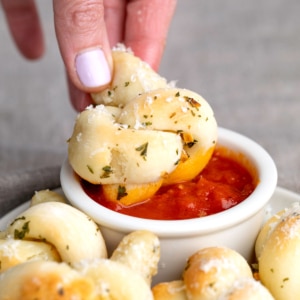
These pull apart gluten free garlic knots are made in a cast iron skillet, so they're crispy on the outside, soft inside. Packed with garlic and herb flavor, they're the garlic knots your guests will remember!

Table of Contents
- Perfecting gluten free garlic knots
- This is the best gluten free garlic knots recipe… seriously
- Ingredients to make gluten free garlic Parmesan knots from scratch
- Tips for making perfect gluten free pull-apart rolls
- Serving gluten free garlic cheese knots
- How to store leftover gluten free garlic knot bread
- Gluten free garlic knots: ingredient substitutions
- FAQs
- Gluten free garlic knots recipe
- Gluten Free Garlic Knots Recipe
Perfecting gluten free garlic knots
In my house, everyone knows the rules about what I'm cooking and baking: Rule #1. Don't ask! The kitchen is not just the kitchen. It's my office, you know? And my laboratory.
If I have to try to put words to what I'm doing, or trying to do, it ruins everything. I'm not thinking in words when I'm cooking, not yet. I'm thinking in concepts, and with my heart.
But when I'm taking my recipe for gluten free pizza and making it into gluten free garlic knots … for the third time in a week? Well there's no hiding in plain sight.
And apparently my children can't help themselves from, at the very least, excitedly sharing the “news” with one another. “Mom's making bacon garlic knots again!!” *subtle*

This is the best gluten free garlic knots recipe… seriously
These skillet garlic knots are more than “just” garlic knots. They're made in a cast iron skillet, which honestly makes alllll the difference.
Instead of fluffy, doughy garlic knots, these are just the right amount of crispy on the bottom and packed with all kinds of delicious flavor and texture—even if you make them without bacon.
Now I haven't tried this or anything, but I suspect that these would even work with my yeast-free gluten free pizza crust. And then of course there'd be no rising.
You'll miss out on all the yeasty goodness in the flavor, but the texture should still be quite good. And with all that bacon, garlic, oregano and basil goodness going on, how could you go wrong?
Ingredients to make gluten free garlic Parmesan knots from scratch
- Gluten free pizza dough – Most of the recipes for gluten free pizza dough here on the blog would work here, except the NY-style crust, or the chickpea crust, which are way too wet to be shaped. The gf pizza dough recipe that I recommend most, though, is our gluten free calzones recipe, as it's very easy to shape and doesn't rise too high.
- Bacon – The only part of the bacon that we really need to make these garlic knots is the rendered fat when you cook it, and that can easily be replaced with more olive oil. Only use the bacon if you want that hit of flavor, and the lovely texture.
- Olive oil – There's both olive oil in the pizza crust here, and in the oil we use to cook the garlic and, ultimately, the garlic knots. It adds a ton of flavor, and can be used to replace the bacon fat, too.
- Garlic – Since these are garlic knots, a few cloves of garlic are central to the flavor. But if you don't want to bother cooking it first in the skillet, you can leave it out, use garlic powder instead, or just add extra dried herbs for more flavor.
- Salt – Salt brings out all the other flavors, and helps tame the yeast in the pizza dough recipe, too.
- Dried oregano and basil – Oregano and basil are the classic pizza spices, and I like to use dried herbs here since they have so much flavor in such a small package. It also makes it more likely that you'll have all the ingredients in your pantry to make these garlic knots.
- Parmigiano-Reggiano cheese – A sprinkling of finely grated Parm after these garlic knots are done baking in the skillet adds all that flavor, but without the risk of overbaking it and making it crunchy in the oven.

Tips for making perfect gluten free pull-apart rolls
Choose and measure your gluten free flour the right way
Like all baking recipes that aren't truly flourless, choosing your gluten free flour blend, and measuring it accurately, is the most important thing you'll do to set yourself up for success.
Here, I find that the absolute best choice for yeast bread is Better Batter's original all purpose blend, with additional tapioca starch/flour for flexibility and chew. And always measure your flours by weight, on a simple digital scale, for accuracy.
Portion your rolls carefully for easy shaping and even cooking
I used to make smaller garlic knots, like you can see in the second full size photo in this post, and divide the dough into 2 dozen pieces. But I find that it's much easier to shape larger pieces of dough into knots, I now make this recipe into about 14 pieces, each about 1.5 ounces in weight.
I highly recommend you portion your dough into pieces using that digital kitchen scale you used to measure your flours. That way, you won't end up with some pieces that are too small to shape, or knots that bake at different rates.
Use the middle oven rack for all-around browning
If you have a gas oven, the bottom rack is closest to the heat and will crisp your garlic knots very quickly, perhaps before they're fully cooked through. The top rack is too far from the concentrated heat and browning takes too long. The middle rack has the most air circulation, and is juuuuust right.
Taper your pizza dough ropes at each end
The gf pizza dough we're using can be shaped, but it's still not quite as stretchy as “regular” gluten pizza dough, since it's the actual gluten that provides stretch. To make your ropes of dough easy to knot, as you're shaping the ropes of dough, pressing lightly toward the ends, press a bit more firmly toward the ends. This will help you feed one end through the loop you create in the center to form a knot.
Be patient as your yeast dough rises
Since we're not making pizza with this dough, we need more rise than just the oven spring (the part of the yeast bread rise that happens in the oven). Be sure to cover your shaped gf garlic knots well so they don't dry out, and be patient until they swell to about 50% bigger (less than double, which is 100% bigger) than their original size.
Yeast bread rises more slowly in a cool, dry kitchen environment, and faster if it's warm and humid. But overproofing is not a function of too long a rise, but too much rising.

Serving gluten free garlic cheese knots
My favorite way to serve these garlic knots is really simply, with some of our best tomato sauce for dipping. Here are some other serving suggestions, some of which will make these knots into a full meal:
- Serve with store-bought pesto sauce, and even try brushing some on the raw, raised knots before you bake them;
- Drizzle with a fancy flavored olive oil right before serving, or use that fancy oil for dipping;
- Serve a half recipe of these knots alongside our lazy summer pasta for a decadent, easy meal;
- Pair these garlic knots with some more finger foods like gf pizza bites on game day.
How to store leftover gluten free garlic knot bread
Like any yeast bread, these gf garlic knots are best the day they're made (that's why they call it “day old bread”!), but if you bake them until they're just slightly brown on top, they'll stay fresh in a sealed container at room temperature for another day or so.
It's best to wait until the day you plan to serve the knots to shape and bake them. But, since you can make the unshaped pizza dough days ahead of time and store it in a sealed container in the refrigerator, you can make the process easily at the last moment.
Do not freeze the raw yeast dough, shaped or unshaped. It may not rise when it thaws, and it's not worth the risk!

Gluten free garlic knots: ingredient substitutions
Dairy free, gluten free garlic knots
The only dairy in this whole recipe is the grated Parmigiano-Reggiano cheese that's sprinkled on the hot, just-baked garlic knots. To make gluten free dairy free garlic knots, you can leave that step out entirely.
For a dairy-replacement alternative, try a dairy-free cheese that you grate finely. I really love Violife brand. A light sprinkling of nutritional yeast would also taste great and even a bit cheesy.
Yeast free, gluten free garlic knots
To make this recipe without yeast, try using our yeast free gluten free pizza dough as the base pizza recipe. The dough will be slightly harder to shape, will be missing that yeasty flavor, and you'll skip the rising entirely, but there should still be enough flavor to keep everyone satisfied!
Meat free, gluten free garlic knots
It's easy to make this recipe meat-free by just omitting the bacon. You'll need to replace the bacon grease with more olive oil, but that's easy as can be! To make sure there's enough flavor, you can try doubling up on the dried herbs and/or the garlic.
GF garlic knot flavor variations
Think of these garlic knots like a blank canvas for your favorite pizza flavorings and toppings. Here are some suggestions:
- Pepperoni pizza pull-aparts — cook chopped pepperoni instead of bacon, then sprinkle with finely chopped or grated mozzarella cheese right after baking, and serve with marinara sauce
- Taco-spiced pizza knots – Add some olive oil to our homemade gluten free taco seasoning to make a paste, and brush that on the knots after rising. You won't even need to sauté the bacon or the garlic, since we'll have plenty of flavor; just replace the bacon grease with extra virgin olive oil.

FAQs
No! Unless they're made with gluten free pizza dough, gluten free ingredients, and in a gluten free kitchen, garlic knots are made with wheat flour, which is not safe on a gluten-free diet. To have gluten free garlic knots, you need a gluten free recipe, like this one.
My favorite way to eat garlic knots is with a quick dip in tomato sauce, when they're fresh out of the oven. Bonus points if they're almost too hot to handle!
Yes! In fact, the gf pizza dough will be easier to handle and will taste better if you place the unshaped dough in a sealed container and let it rest in the refrigerator overnight. I don't recommend letting the shaped knots rise in the refrigerator overnight, though, as they may overproof.
To tie gluten free garlic knots without tearing the dough, be sure to sprinkle lightly with tapioca starch to shape a smooth dough, roll a rope about 4-inches long that tapers slightly and gradually from the center to each end.
Make a loop by crossing the rope on itself about 1.5-inches from each end, then feed one end through the center hole. Turn the knot on its side, press it together gently to seal, and place it in the prepared skillet.
You can freeze the baked and cooled knots, yes. Make sure they're completely cool, and wrap them very tightly to prevent freezer burn. Defrost them by placing them on a lined baking sheet in a single layer, sprinkling them with water, and warming them in a 300°F oven until warmed and crisped.
I like to make these garlic knots in a cast iron skillet since it holds heat in a hot oven so well that the bottoms will brown beautifully without having to bake the tops until they're super dark brown.
But you can make them in nearly any baking dish or cake pan. For them to be “pull apart” garlic knots, they'll need to be close enough to touch at least a little before you bake them.
No! This recipe is only for dough that's meant to be shaped. To make gluten free garlic bread, you need our recipe for gluten free French bread baguettes.

Gluten free garlic knots recipe
Gluten Free Garlic Knots Recipe
Equipment
- Stand mixer with paddle attachment (or food processor)
Ingredients
For the pizza dough
- 2 cups (280 g) all purpose gluten free flour blend, (Better Batter highly recommended; please click thru for appropriate blends)
- 1 teaspoon xanthan gum, omit if your blend already contains it
- ⅓ cup (36 g) tapioca starch/flour, plus more for sprinkling
- 2 teaspoons (6 g) instant yeast
- 1 ½ teaspoons (6 g) granulated sugar
- 1 teaspoon kosher salt
- 1 cup (8 ounces) warm water, (about 95°F)
- 2 tablespoons (28 g) extra virgin olive oil
For the garlic knots
- 6 ounces thick-cut bacon, diced (See Recipe Notes)
- 4 tablespoons (56 g) extra-virgin olive oil, plus more for drizzling
- 6 cloves garlic, peeled and minced
- ½ teaspoon kosher salt
- 2 tablespoons dried oregano, crushed between your palm and forefinger
- 1 tablespoon dried basil
- 1 ounce finely grated Parmigiano-Reggiano cheese
- Tomato Sauce, for serving
Instructions
Prepare the dough.
- In the bowl of your stand mixer fitted with the paddle attachment or your food processor fitted with the metal blade, place the flour, xanthan gum, tapioca starch, yeast, and sugar.
- Whisk to combine with a separate, handheld whisk. Add the salt, and whisk again to combine well.
- Add the water and olive oil, and mix on medium speed in your stand mixer or pulse in your food processor until the dough begins to come together. Turn the mixer to high speed or your food processor on and process for about 2 minutes.
- Transfer the dough to an oiled container with a tight-fitting lid or a greased bowl and cover tightly. Refrigerate the dough for at least 1 hour and up to 3 days.
Prepare the garlic mixture.
- In a 12-inch cast iron skillet (or another heavy-bottom skillet), scatter the diced bacon in a single layer in the dry skillet and cook over medium heat until evenly golden brown and crisp (about 7 minutes).
- Remove the cooked bacon from the skillet and place it in a small bowl to cool. Leave about 2 tablespoons of the bacon grease in the skillet, and remove the rest (save it for another use).
- Add one tablespoon of olive oil to the bacon grease remaining in the skillet. Add the garlic, and cook it in the skillet over medium-low heat until fragrant and very lightly golden brown (about 2 minutes).
- Transfer the cooked garlic and remaining 3 tablespoons of olive oil to the bowl with the cooked bacon, add the oregano and basil, and mix to combine. Set the bowl aside to cool.
- Remove the skillet from the heat and set it aside to cool while you shape the pizza dough. If you don’t have a cast iron skillet, you'll need to grease a 9-inch round baking dish for baking the shaped and prepared garlic knots.
Shape the pizza dough.
- Remove the dough from the refrigerator, uncover it, sprinkle it lightly with tapioca starch, and knead it a bit until it’s smoother.
- Sprinkling with more tapioca starch as necessary to prevent sticking, and, using well-floured hands and a bench scraper or sharp knife, divide the prepared pizza dough into about 14 equal pieces, each about 1.5 ounces.
- Roll each piece into a ball and then, using the tips of the fingers of both hands and using gentle but steady pressure away from you and out to the sides, roll each small ball of dough into a rope about 4 inches long. To make knotting easier, taper the dough gradually from the center to each end.
- Shape each into a knot by first forming a loop by crossing one end over the other about 1.5 inches from each end. Then, poke one end through the loop you created as far as possible without tearing the dough.
- Turn the knot on its side, press it together gently to seal, and place it in the prepared skillet or baking dish. Repeat with the remaining pieces of dough, placing the knots close together but not touching, if possible, in a single layer.
Get the knots ready for the oven.
- Using a pastry brush, brush all the knots generously with the garlic and herb oil/bacon mixture, making sure the bacon gets evenly distributed.
- Drizzle the top of the knots lightly with more olive oil. Cover the skillet with the lid of your skillet if you have one, or a lightly oiled piece of plastic wrap if the skillet is cool to the touch (otherwise, use foil).
- Place in a warm, draft-free location to rise until about 1 1/2 times its original size (about 1 1/2 hours, but rising times will vary significantly depending upon the rising environment—be patient!).
Bake the garlic knots.
- About 30 minutes before the rise is complete, preheat your oven to 375°F and place the rack in the middle of the oven.
- Once the rise is complete, uncover the skillet, drizzle lightly with more olive oil and place on the center rack.
- Bake until the knots are lightly golden brown all over, and slightly darker brown in spots (about 20 minutes). For crispier knots, bake for at least 5 minutes more, rotating the pan 180 degrees after the first 15 minutes of baking.
- Remove from the oven, sprinkle the grated Parmigiano-Reggiano cheese on top and allow to sit briefly while the cheese melts before serving with tomato sauce for dipping.
Tell Google you trust GFOAS!
Notes
Nutrition
Nutrition information is automatically calculated, so should only be used as an approximation.










Honest review – These are not my favorite. Normally I feel like Nicole’s recipes are always a win. Maybe it’s just me, but these weren’t it for me. I have used the GF naan recipe for garlic knots in the past and it has been amazing. This recipe just seemed kinda dry and a little dense by comparison.
Hi, Leanne, thanks for your honest feedback. If you’re able to use my gluten free naan recipe and twist it into garlic knots, your dough is actually much more dry than it should be, most likely due to the flour blend you’re choosing, measuring by volume instead of weight, or some other variable. That would also account for why this recipe came out dry for you.
Mine didn’t rise over 3 hours at all with fresh yeast. Baked anyways and were extremely doughy in the middle not cooked. Where did I go wrong? I flowed the recipe to a “T”.
Everyone thinks that they followed every recipe “to a T,” but I’m afraid that’s almost never the case. This isn’t a high-rising dough, and it’s hard to imagine how it would have not risen “at all,” yet would be wet in the middle when cooked. Yeast dough that hasn’t risen bakes hard and dry. Without knowing where you deviated from the recipe as written, here is what I always recommend for troubleshooting:
Could I use active dry yeast instead of instant yeast?
Yes, but you’ll have to use 25% more yeast, by weight, and dissolve it in some of the liquid first.