

This post may contain affiliate links. Please read our disclosure policy.
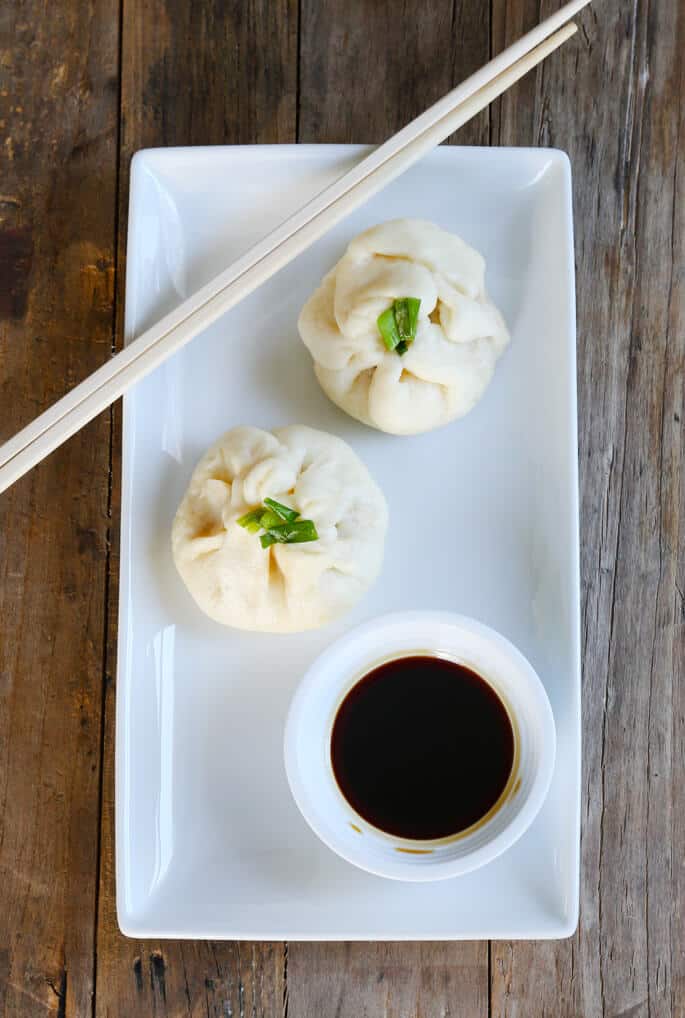
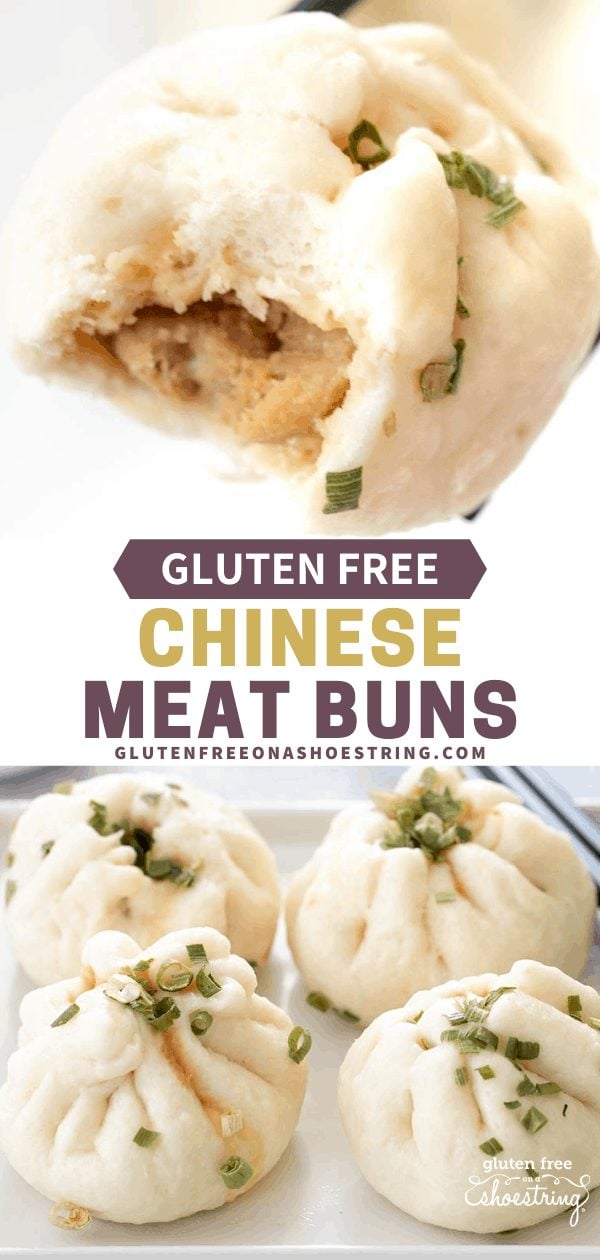
These gluten free bao buns are steamed Chinese meat buns that are a simple savory meat mixture wrapped in pillow-soft steamed dough. Cook in a steamer basket or in soup!

Table of Contents
- What makes these Chinese gluten free bao buns special
- How to steam the buns perfectly
- How to shape the dough for these gluten free Chinese meat buns
- Can I use the dough to make gluten free bao?
- Steamed gluten free Chinese meat buns: Ingredients and substitutions
- Gluten free Chinese meat buns recipe
- Gluten Free Steamed Chinese Meat Buns Recipe
What makes these Chinese gluten free bao buns special
These gluten free steamed Chinese meat buns are soft and fluffy, with the most gorgeous savory filling. I adapted the recipe from someone who knows, since I certainly did not know.
The filling is largely the same as the recipe from which I adapted it. The dough is the real star, and that required some more work to recreate as gluten free.
I prefer the recipe to be made with my gluten free bread flour from (don't worry it's all explained in the Recipe Notes below), but I also tested it with my gluten free pastry flour (also all explained in the Recipe Notes below) and it does, in fact, work.
Light and fluffy steamed gluten free bao buns filled with a delightfully gingery, salty beef mixture, whether you're missing these buns because you know, or you've never had them, you're in for a treat. As my kids said when they first tried them, “Oh, these are like gluten free potstickers! Except even better.”
How to steam the buns perfectly
I only steam these buns for 8 minutes, and then allow them to rest for about 2 minutes after steaming. You can't peek during steaming (!) or you'll let out the steam.
I've tried steaming the buns for as long as instructed in the original recipe, and found that they turned out tough. The purpose of steaming these buns rather than baking them is to maintain moisture and provide indirect heat.
If you're at all concerned that your buns might not be completely cooked in 8 minutes, I recommend allowing them to sit, still covered, off the heat for longer. You won't overcook them that way, and it should put your concerns to rest.
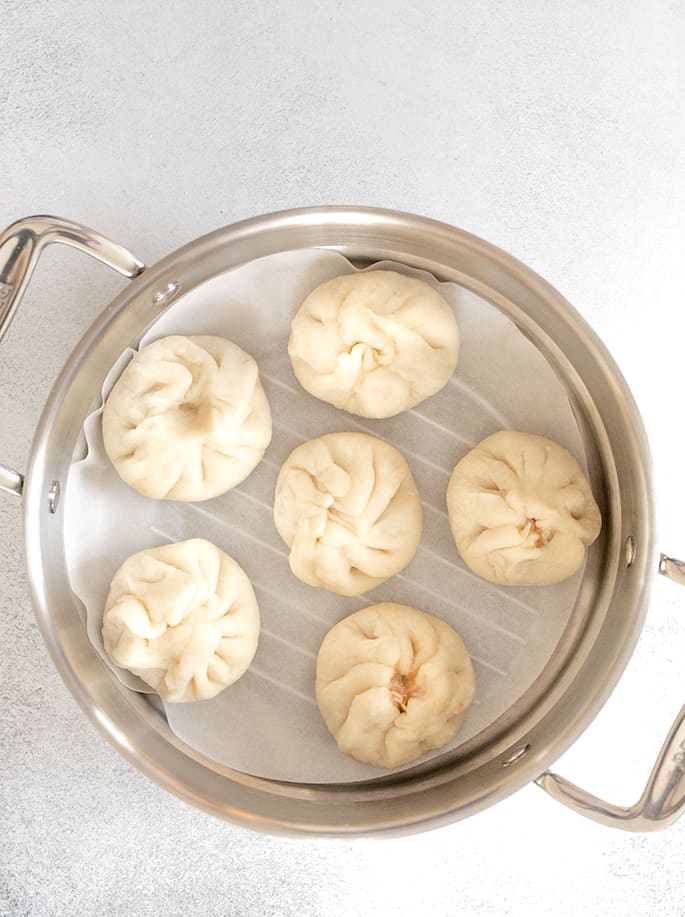
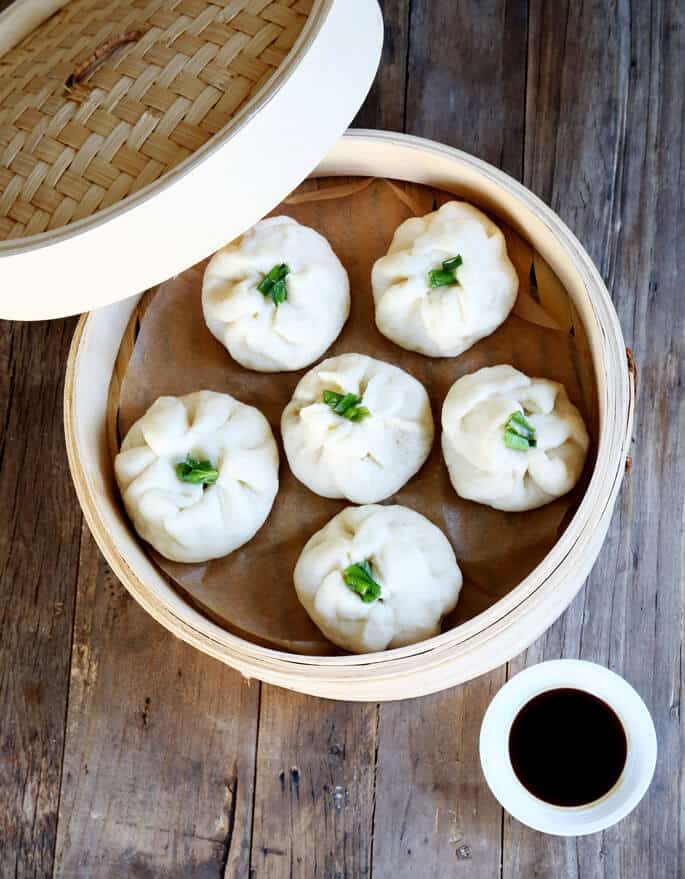
I do have a bamboo steamer basket, but I have also made these with a metal steamer. If you don't have either a bamboo or metal steamer, you can try making these buns in an oiled cast iron skillet.
Fill the skillet at least half way up the sides of the buns, cover, and simmer until cooked through. It might be messy, but it should work—and create a bonus browning on the bottom of the buns.
You can also boil these buns in simmering chicken stock or beef stock, depending upon the meat you've chosen for your filling. I would make them smaller (about half the size called for in the recipe) if you're planning to serve them in soup.
How to shape the dough for these gluten free Chinese meat buns
To shape the dough, the best way to imagine it is by watching the how-to video in this post. If you are sighted but don't see the video, it can only be because you're using an ad blocker. Please turn it off both to see the video and because that's the only way I get paid at all for my work.
If you aren't sighted or you're less of a visual learner, I recommend you read the recipe instructions all the way through at least once before beginning. That's the best way to understand the mechanics.
Tips for shaping these buns
As a general concept, first pull of a small piece of dough and roll it into a tight ball. Then, flatten the ball of dough into a round about 4-inches in diameter using first the heel of your hand, and then a rolling pin (the smaller the better).
For best results, thin about a 1-inch border all around the shaped dough until it's no more than 1/8-inch thick. The rest of the round of dough will remain a bit thicker so that the filling doesn't leak. This ensures that the pleats you're about to create aren't too thick.
Then, place the shaped dough in the palm of one hand, fill, and begin to gather the ends of the dough together up and over the filling like an accordion, making your way around until the bun is sealed. Gently twist the raised center gently.

Can I use the dough to make gluten free bao?
Yes, I have, indeed, tried using this dough to make bao. It was really exciting and I'm going to make it a permanent part of my life. The bao I'm referring to here are folded, steamed dough buns, typically filled with crispy meat, scallions and cucumber. Unlike the closed steamed boa buns, these are open on one side, the filling added after they've steamed. I love them, they're like little fluffy dough tacos.
I can't give you actual instructions yet, because I'm still learning and perfecting my technique. If you already know what you're doing making Chinese meat buns and you just needed me for the gluten free dough recipe, then don't wait for me! I'll catch up eventually and I will share if there's interest.
Steamed gluten free Chinese meat buns: Ingredients and substitutions
Gluten free dairy free Chinese meat buns
If you make this recipe using my gluten free bread flour blend, dairy is essential. If you use a gluten free pastry flour blend (see Recipes Notes for details), you can use coconut milk powder in place of dairy milk powder. And in place of the dairy milk in the dough, use your favorite unsweetened nondairy milk.
About the instant yeast in this recipe for gf Chinese meat buns
This gluten free bao buns recipe calls for instant yeast, which is also called breadmaker or rapid-rise yeast. There is no substitute for yeast in a yeasted bread recipe.
In place of instant yeast, you can use active dry yeast, though. Simply multiply the amount (by weight) of the instant yeast (here, 5 grams) by 1.25 or 125% to get 6 1/4 grams of yeast. My scale isn't sensitive to less than a whole gram, but just add a bit more after you reach 6 grams.
Active dry yeast has a thicker coating around the yeast. You should soak it in some milk in the recipe until it foams before adding it to the dough with the rest of the milk.
Gluten free Chinese meat buns recipe
Gluten Free Steamed Chinese Meat Buns
Equipment
- Stand mixer
- Steamer basket
Ingredients
For the bread dough
- 3 ½ cups (490 g) gluten free bread flour, (See Recipe Notes), plus more for sprinkling
- 1 ⅔ teaspoons (5 g) instant yeast
- ¼ cup (50 g) granulated sugar
- 1 teaspoon baking powder
- ½ teaspoon (3 g) kosher salt
- 2 tablespoons (28 g) neutral oil, (like canola, vegetable, or grapeseed)
- 1 ⅛ cups (9 fluid ounces) warm milk, plus more if needed (11 to 11 1/2 ounces if using gluten free pastry flour in place of bread flour) (See Recipe Notes)
For the filling
- 3 tablespoons minced fresh ginger, peel the ginger by scraping with a spoon, slice into coins, slice the coins into matchsticks, then mince
- 3 tablespoons tamari or gluten free soy sauce, plus more for serving
- 1 tablespoon (12 g) granulated sugar
- 2 tablespoons mirin, rice cooking wine
- 1 teaspoon (5 g) toasted sesame oil
- 2 teaspoons (9 g) neutral oil, (like canola, vegetable, or grapeseed)
- 1 teaspoon freshly ground black pepper
- 1 pound lean ground pork, chicken or beef (if you use nearly fat-free ground meat, like ground chicken, add 2 more teaspoons vegetable oil to the filling)
- ½ cup shredded cabbage, I used bagged shredded cabbage with shredded carrots
- Chopped scallions, for serving (optional)
Instructions
- Line the bottom of a steamer basket (metal or bamboo) with parchment paper, and set it aside.
Make the bread dough.
- In the bowl of a stand mixer fitted with the bread hook (or fitted with the paddle attachment if using pastry flour in place of bread flour), place the flour blend, yeast and sugar, and whisk to combine well.
- Add the baking powder and salt, and whisk to combine well. Add the oil and milk, and mix on low speed with the dough hook (or paddle if using pastry flour) until combined. If the dough seems at all dry, add another tablespoon or two of milk.
- Raise the mixer speed to medium and knead (or mix) for about 5 minutes. The dough will begin as a rough ball and become very sticky, but should be smooth and somewhat stretchy (if using pastry flour, the dough will clump and begin to come together in shards, more like play-doh).
- Spray a silicone spatula lightly with cooking oil spray, and scrape down the sides of the bowl.
- Transfer the dough to a lightly oiled bowl or proofing bucket, and cover with an oiled piece of plastic wrap (or the oiled top of your proofing bucket).
- Set it in a warm, draft-free location to rise for about 45 minutes or until it is about 150% of its original size (if using pastry flour, the dough will rise less).
- Place the dough in the refrigerator, still covered tightly, to chill for about 10 minutes. This will make it easier to handle.
Make the filling.
- In a medium-size bowl, place the ginger, tamari, sugar, mirin, sesame oil, vegetable oil, and pepper, and mix to combine well. Set the bowl aside.
- In a large bowl, place the ground meat and the cabbage, and mix to combine. Add the ginger/soy sauce mixture to the large bowl of meat and cabbage, and mix to combine well.
- Cover the bowl and place the mixture in the refrigerator to chill.
Shape the buns.
- Remove the dough from the refrigerator and turn it out onto a lightly floured surface. Sprinkle lightly with additional flour, and shape into a smooth ball (this will be much, much easier if you used bread flour).
- Divide the dough evenly into four separate pieces, then each piece into 4 equal pieces. Sprinkle all the pieces of dough lightly with flour, and cover all but one with a moist tea towel so that they don’t dry out.
- Using well-floured hands, roll the exposed piece of dough into a round between your palms. Place the dough back on the flat surface and press down into a disk with the heel of your hand.
- Using well-floured fingers, flatten the dough into a round about 4-inches in diameter, working from the inside out and leaving the center of the dough much thicker than the edges.
- This will keep the filling from leaking out during steaming and keep the pleats from being too bulky. Remove the chilled filling from the refrigerator and place about 1 1/2 tablespoons of filling in the center of the shaped piece of dough.
- With well-floured hands, gather the ends of the dough together up and over the filling like an accordion, making your way around until the bun is sealed. Gently twist the raised center of the dough, and place the bun in the bamboo steamer on the parchment.
- Repeat with the remaining dough and filling, placing the buns about 1 1/2-inches apart from one another. Cover the buns with the lid of the steamer or a large piece of oiled plastic wrap and allow to rise for about 30 minutes or just until the buns have begun to swell.
Steam the buns.
- Place the steamer, still covered, over just enough simmering water on the stovetop that the water nearly touches the bottom of the steamer, but does not.
- Steam over high heat for 8 minutes, replenishing the steaming water as it evaporates.
- Turn off the heat and allow the steamer to sit, covered, for another 2 to 4 minutes or until the buns are fluffy but relatively firm to the touch.
- Scatter a few chopped scallions on the top of each bun, and serve warm with a side of tamari or gluten free soy sauce.
Video
Tell Google you trust GFOAS!
Notes
- About the gluten free bread flour blend called for in this recipe: I have a whole post explaining all about my gluten free bread flour recipe. For questions regarding substitutions in that blend, how to create it, and how to handle it, please click over.
- If you’re already comfortable with my bread flour blend, here are the weight measurements for making the 3 1/2 cups (490 grams) required for this bread dough:
- 350 grams Better Batter original blend all purpose gluten free flour or my better batter gluten free flour
- 88 grams whey protein isolate
- 52 grams Expandex modified tapioca starch
- To use Pastry Flour in place of gluten free bread you will need to make the following changes to the recipe and instructions:
- In place of the 1 cup + 3 tablespoons (9 1/2 fluid ounces) warm milk, use 1 1/4 cups + 2 to 3 tablespoons (11 to 11 1/2 fluid ounces).
- As a pastry flour, you may use any of the following: Cup4Cup Gluten Free Flour (the actual brand), my Mock Cup4Cup Gluten Free Flour, my Better Batter Pastry Flour Hack. In place of milk powder in the “mock” recipes, you can use coconut milk powder if you need a dairy-free version.
- Dough made with one of the pastry flour blends will need to be handled differently, and baked differently. It will be softer and not stretchy, and more prone to tearing. Please handle it carefully.
Nutrition information is automatically calculated, so should only be used as an approximation.











Nicole, thank you for this! Do you cook the pork before filling the buns, or does it cook while the buns are steaming?
If you precooked it, I would certainly instruct you do that, Scott! It all steams together.
I’m sorry but your answer didn’t make much sense to me. Do we cook the meat before we make the filling or does it steam?
No, it isn’t precooked, Evie. If it were, the recipe would be specific about that. It cooks fully along with the buns.
Hi, Nicole!
In this Chinese bun recipe, can I JUST use Better Batter for the flour? I don’t have whey isolate…
Thank you!
Love your recipes! Will get ur cookbook!
Carmen;))
Please see the discussion in the recipe about using my gluten free pastry flour blend instead of my gluten free bread flour blend, Carmen. That is the only alternative (not Better Batter alone). It is all explained in detail right in the recipe and recipes notes.
Hi Nicole, I will definitely make these steamed baos soon! Can’t wait to eat them! Could I make a request of the Chinese bo lo baos, or pineapple buns? Or even the Chinese bbq baked pork baos. :)
Nicole, I didn’t see your post about the Instant Pot till I wrote a response to DORRIE. And you were pretty much right on. I added boiling water between batches so the IP didn’t run out.
And for the buns – perfect flavor and texture! But, mine were HUGE. I like a good large pork bun, but the ones in your pictures don’t look at big as what I ended up with. So, I made some that were smaller, and they were great too. The reminder of the dough is in the fridge, and I’m going to finish making them today, so I’ll see how the dough holds up overnight. Thank you! If I can make a request – tapioca dumplings Har Gow next after Bao…
Thank you for sharing how well that worked, Meg! It sounds like you and were thinking right along the same lines for the method.
The dough will hold up if it’s sealed well in the refrigerator, but I recommend letting them rise for about half the time after shaping as they’ll have a tendency to rise a lot more during steaming.
I looked up Har Gow, and it seems like it’s made with a combination of wheat starch and tapioca starch, plus a fat and boiling water? They look amazing, but already nearly gluten free if you find a good replacement for the wheat starch (which should be a bit easier than finding a replacement for wheat flour). I’ve been thinking of trying homemade cheung fun noodles, but I don’t plan to share a recipe since it won’t be mine.
DORRIE BERKOWITZ – I used an Instant Pot last night to steam the buns. Worked great! I used the Saute function, rather than the steam function, and placed the lid loosely on top – don’t engage the lid, or you will get a “lid” warning. If you use the Steam function, you will need to lock the lid on, and release the steam to open the lid, so you loose control over the steaming time. If you don’t have a steamer basket, you can steam the buns on a plate that fits inside your IP.
Looks like a great recipe — thanks for working so hard for us! Question: What are your thoughts on steaming these in an Instant Pot?
Funny that you should ask that question, Dorrie, because I kept wondering if that would work! You definitely should not pressure cook them, because they’ll end up tough. But you might be able to steam them by placing water in the Instant Pot liner, then placing a steamer rack on top, lining it, placing the buns on top, and then turn the pot on to cook (not pressure cook), with the lid on but not secured. It would be a bit risky, though, because the water could all evaporate and you wouldn’t know until it was too late.
Hi Nicole,
These buns look masterful! They must have been so much work to develop. Do you think you could use this dough for bao buns?
Thanks!!
Alonna
Hi, Alonna, I actually talk about that in the post. I think the answer is yes! I’m just refining the recipe and technique.