

This post may contain affiliate links. Please read our disclosure policy.
There are many ways to make pierogi, and everyone seems to have their favorite. This is my favorite recipe for gluten free potato pierogi, as the dough is made with both milk and sour cream.
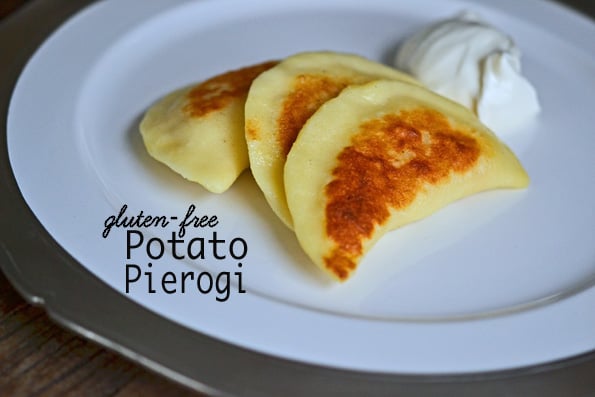
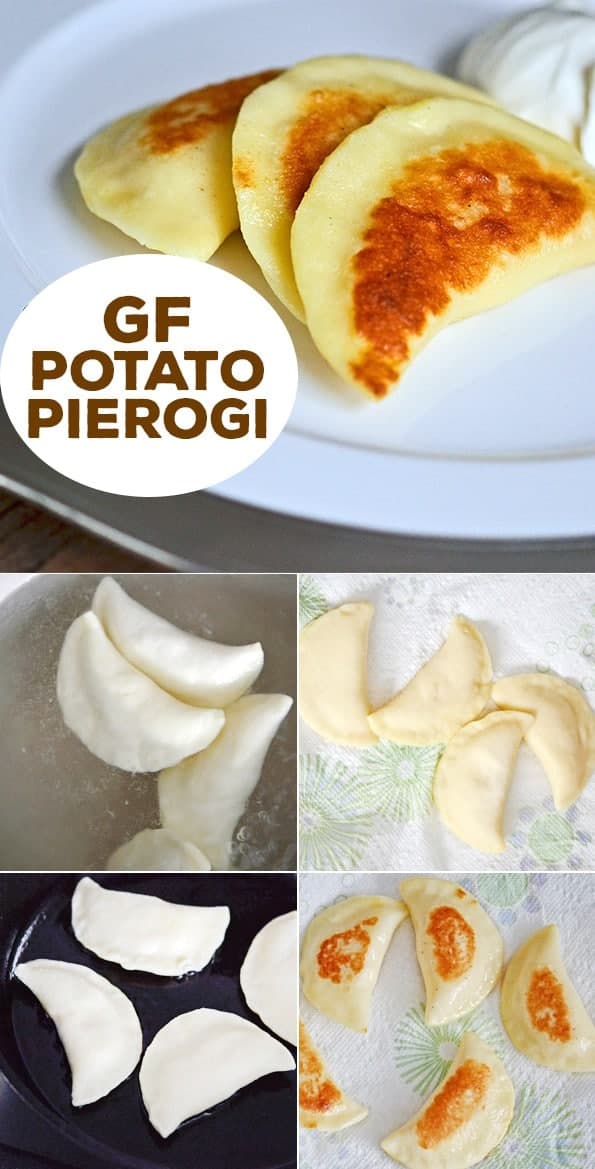
There's no way around it. Pierogi takes some time to prep. I promise that this dough will work – just read the recipe all the way through before you roll up your sleeves and get to work. And let all the step by step pictures mesmerize you for a bit, too.
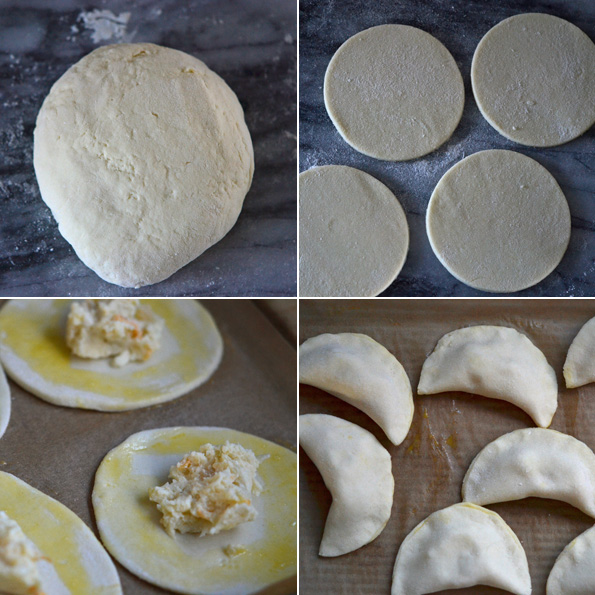
Semi-Pro Tip #1: Rather than struggling to roll out the dough as thin as 1/8 inch before cutting rounds, roll it out 1/4 inch thick. Then, reroll each round into an oval that is closer to 1/8 inch thick.
This way, you're much less likely to have a dough of uneven thickness (which might cause some of them to break during boiling), and an oval shape is easier to form into half-moons.
Be careful as you select your gluten-free flour blend for this task, too. Anything that is too high in starch, like Trader Joe's All Purpose Gluten Free Flour, is going to be difficult to roll out smooth as it will absorb too much moisture in the dough.
This is a different dough than, for example, gluten free pie crust, which is flaky as any proper pastry would be that is meant to be baked in a hot oven. Pierogi dough has more chew, and is less fragile by nature.
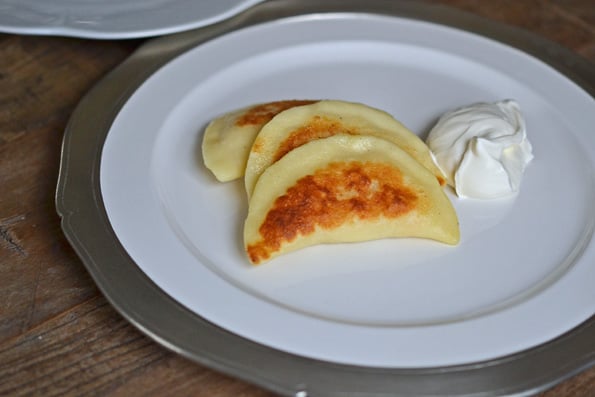
Just be sure to serve these to someone special. Pierogies bring to mind Easter for me, which may or may not be strange. But one thing's for sure – if you're going to make them for a big group, pay special attention to the Make-Ahead Option in the printable recipe below. Now … how do you say “EAT!” in Polish?
How to make homemade gluten free pierogi, step by step
Gluten Free Pierogi Recipe

Ingredients
For the dough
- ½ cup (112 g) sour cream, at room temperature
- ⅔ cup (170 g) milk, at room temperature
- 1 (50 g (weighed out of shell)) egg, at room temperature, beaten
- ⅛ teaspoon kosher salt
- 2 ½ cups (350 g) all purpose gluten free flour blend, (I used my Better Than Cup4Cup Blend; please click through for appropriate flour blends), plus more for kneading
- 1 teaspoon xanthan gum, omit if your blend already contains it
For the filling
- 1 pound potatoes, about 8 small red skin potatoes or 1 large potato
- 1 small onion, peeled and diced
- 2 tablespoons (28 g) clarified butter or ghee, can substitute olive oil
- ½ cup (112 g) sour cream, at room temperature
- ½ cup (2 ounces) shredded semi-hard cheese, (I used a blend of Monterey jack and cheddar)
- Kosher salt and freshly ground black pepper, to taste
For finishing
- 1 egg (any size), beaten
- 2 tablespoons (28 g) ghee or clarified butter, can substitute olive oil
Instructions
Make the dough.
- In a large bowl, place the sour cream, milk, beaten egg and salt, and whisk to combine well. Add the flour and xanthan gum in three parts, mixing well to combine after each addition.
- The dough will come together and be relatively smooth but still a bit sticky. Turn it out onto a lightly floured surface, and, with floured hands, knead the dough until it becomes easier to handle (it will not be completely smooth).
- Cover the dough loosely with plastic wrap and set it aside to rest.
Make the filling.
- Bring a large pot of salted water to a rolling boil, add the potatoes and reduce the boil to a simmer. Boil the potatoes, covered, until they are just fork tender (about 15 minutes).
- Drain the water from the pot of potatoes and cover the pot with a tea towel. Allow the potatoes to steam beneath the towel until the are softened (about another 10 minutes).
- While the potatoes are cooking, place the diced onion and clarified butter in a small skillet and cook, stirring frequently, until the onions are translucent (about 6 minutes).
- Once the potatoes are softened, peel the skin off (it should come off easily) and mash the potatoes in the pot. Add the cooked onions, then the sour cream, shredded cheese and the salt and pepper to taste. Set the filling aside.
Roll out the dough.
- On a lightly floured surface, roll out the dough into a round about 1/4 inch thick, and moving the dough frequently and dusting lightly with flour to prevent sticking as you roll.
- Cut out rounds 4 inches in diameter from the dough. Gather and reroll scraps. Roll each round into an oval that is closer to 1/8 inch thick (the thickness of a nickel).
Assemble the pierogies.
- Paint the edges of each oval with the beaten egg, then place about 1 tablespoon of filling in the center of each.
- Fold the dough over on itself, matching the edges, and pinch the edges together to form a tight seal.
Boil the pierogies (See Recipe Notes).
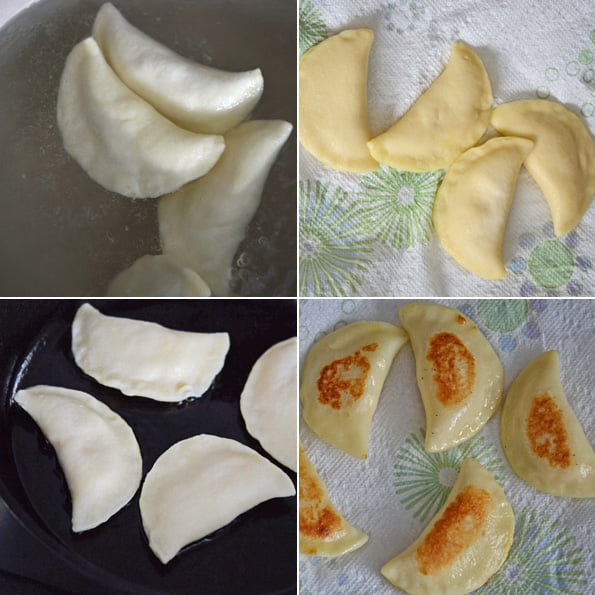
- In a large pot of salted, boiling water, place the pierogies, about 6 at a time, until they float to the surface of the water (about 3 minutes).
- Place the boiled pierogies on a paper towel to drain, then blot them dry.
Finishing.
- Sauté the towel-dried pierogies in ghee in a large skillet until browned, about 2 minutes per side. Serve immediately.
Notes
Nutrition
Nutrition information is automatically calculated, so should only be used as an approximation.











Hello Nicole,
Thank you for all of your wonderful gf recipes and the hard work involved creating them!
I would like to make this recipe ahead of time for the holidays, but was wondering if after filling I could immediately freeze on a cookie sheet and then bag, without boiling first? …And then, when ready to serve, gently boil them directly from the freezer and then sauté
(with lots of onions and served with sour cream on the side! ?). Thank you again!
Hi, Janie, you’re so welcome and thank you for the kind words! Sure, you can shape, fill and freeze them raw. I would defrost before cooking, though.
Can I prepare the dough ahead of time, chill in the fridge, and make the pierogies later?
Hi, Kay, you can prepare the dough ahead of time, refrigerate, and then make pierogies later as long as you’re very careful to prevent any moisture loss during refrigerating the dough. You’re better off making the dough, filling and shaping them pierogies, then wrapping them tightly and storing in the refrigerator. Then, let them come to room temperature before cooking. If there is any moisture loss in the unfilled dough, it will become much more difficult to shape later.
These look fantastic! I have not made them yet, but I’m thinking of subbing full fat coconut milk, which is the same fat and consistency of regular milk, and some thick coconut yogurt for the sour cream, since I also don’t eat dairy. I’ll post back if they come out good.
Hi, Shari, full fat coconut milk from a carton would probably work well. From the can, it has much less moisture than cow’s milk and it won’t work.
I almost never comment on things, but this recipe blew my mind and means a lot to me! My grandma is 100% Polish, and my family makes pierogi together every Christmas time to eat on Christmas Eve. When I married my gluten free husband, I thought he wouldn’t be able to partake, but the first year we were married, I embarked on an experimental labor of love. I bought all the ingredients for the Better than Cup4Cup blend and made this dough (with my family’s filling recipe)– that was four years ago, and every year, I still can’t believe it works! **I do always find I need to use more flour than this calls for to achieve a stretchable, not too sticky texture.** And while my pierogis still often tear a little with this dough, they always hold up perfectly in boiling water and taste great! So a big thank you from a 1/4 Polish girl and her GF husband! ;)
These were fantastic. I used Bob’s Redmill gluten-free flour and added a little bit more sour cream for moisture to get the consistency right. I also used a tortilla press to get them quickly pressed out into circlesI sautéd them in ghee and Sage. Definitely a keeper recipe!!
So glad you enjoyed them, Wendy!
Can I use cloud 9 gluten free flour for this recipe?
I’m afraid I’ve never heard of that blend, Kristin, so I can’t predict how it will perform. Sorry I can’t be more helpful!
I used the cloud 9 GF flour and it worked amazingly! Thank you for this recipe
Can’t wait to try these! Do you think King Arthur GF flour would work?
Hi, Jaime, I’m afraid I don’t like the KAF GF Measure for Measure blend and don’t recommend it for this recipe. For more information on my favorite blends, please see this all purpose gluten free flour blends page.
I cannot thank you enough for this incredible absolutely PERFECT Pierogies dough. I made it using the recommended GF flour blend suggestion – 3 cups ( but measured in recipe by grams) the extra was perfect amount for rolling – sealing. I made a potato feta filling. This dough is even better than it’s gluten counterpart- very light , not doughy or heavy- & of course – no “no gluten spring back “
You’re so welcome, Jonie, and I’m so glad you had success and that you measured by weight. It’s the only way to have consistent results, so next time will be as successful as this time!
What type of milk was used in your recipe?
Unless it’s otherwise specified, milk is always cow’s milk, Beth!
Correct, but I meant skim, 1 or 2% or whole?
Ah, I always recommend using whole milk wherever possible, unless I’ve specified otherwise, but 2% will work. Always avoid skim or even 1%, which has so little fat so it’s not rich and has a lot of water.
Great, thank you! I looked forward to making these and appreciate your help.
I am looking forward to trying this recipe! Do you recommend a fat percentage for the dairy products?
Always use at least 2% fat dairy products in dough and baking, Cathy!