

This post may contain affiliate links. Please read our disclosure policy.
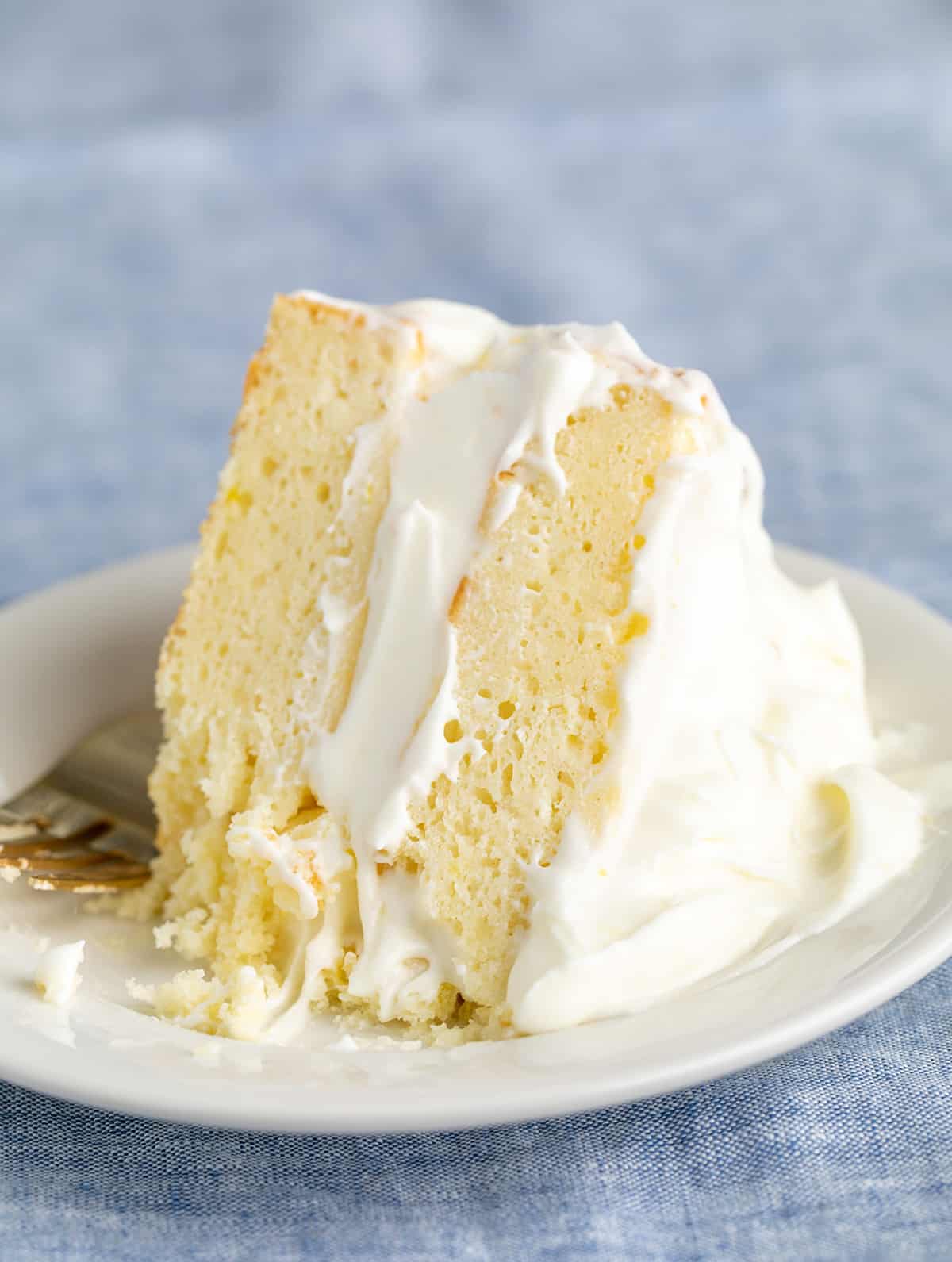
This gluten free lemon cake, bursting with lemon flavor, has the smooth and fluffy lemon cream topping that tastes like everyone's favorite Olive Garden cake!
The secret to the most lemon flavor without making the cake heavy is brushing the baked cake with even more lemon juice as it cools. You won't believe the difference it makes!
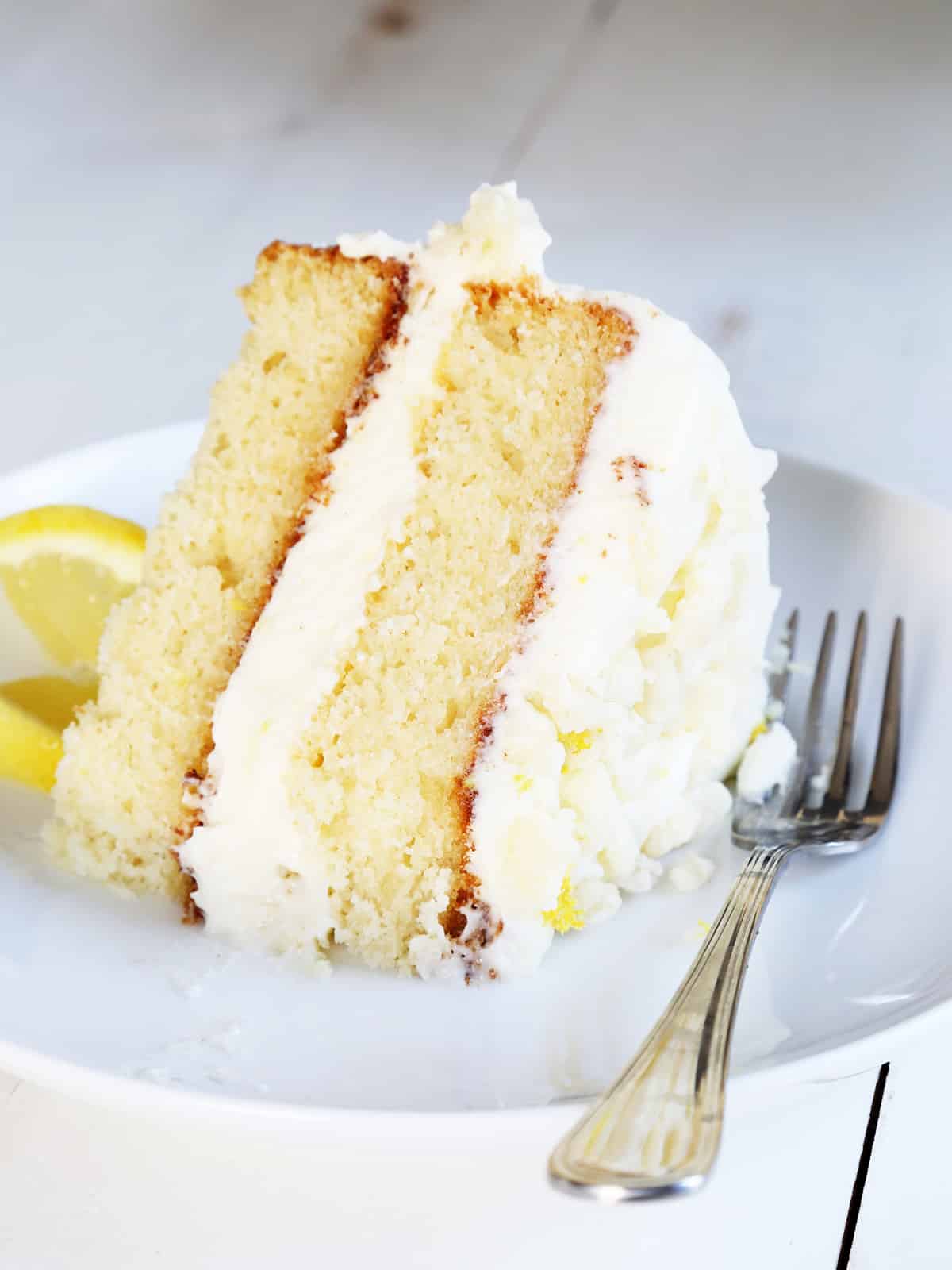
“This was my birthday cake, and it was delicious. Family who had it didn’t believe it was safe for me to eat as it must have gluten!”
my take
Nicole's Recipe Notes
- Taste and texture: Incredibly tender and moist white cake with tons of lemon flavor from lemon zest and lots of fresh juice.
- Perfect frosting and filling: Filled and topped with light and bright lemon cream frosting.
- Authentic copycat: If you miss the Olive Garden lemon cream cake, add in the simple lemony crumb topping!
- Stays moist: There's plenty of lemon juice in the batter, and then we brush the baked cakes with even more, so this cake stays moist for days.
I love making cakes and have several others on my site. Try out my gluten free carrot cake, gluten free chocolate cake and my gluten free carrot pineapple cake as well!
what's in it
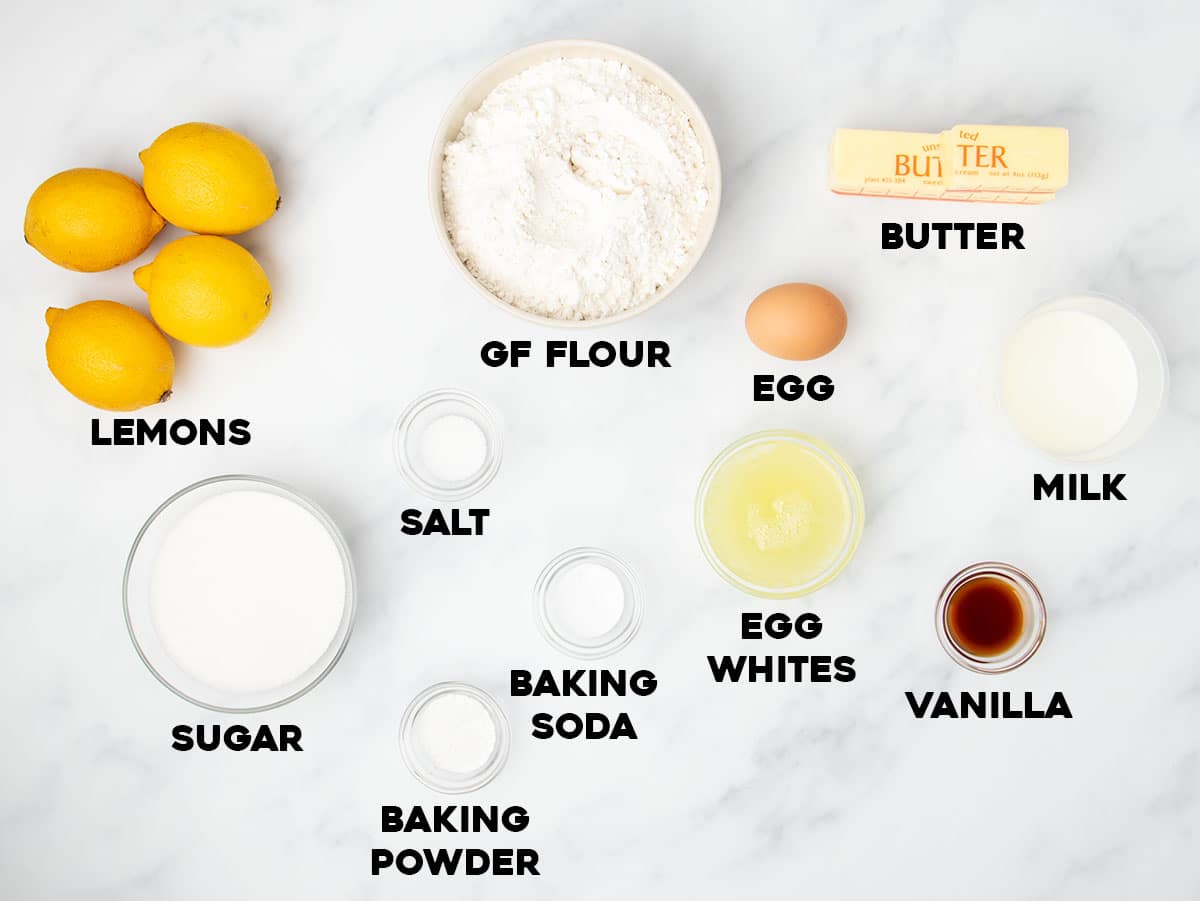
Recipe ingredients
- Gluten free flour: Use one of my recommended gluten free flour blends here, adding xanthan gum if your blend doesn't already contain it. Be sure to measure by weight, so your measurements are accurate.
- Salt: Brightens the lemon and other flavors in the cake, balances sweetness.
- Baking powder/baking soda: Add rise and aid in browning in the oven.
- Butter: For richness and mouth feel. We use unsalted butter because it has less moisture than salted butter and that allows us to control the amount of salt in the recipe.
- Sugar: Adds sweetness and tenderness. Don't reduce the sugar or your cake will be dense.
- Egg/egg whites: For structure, rise, and some richness. We use 1 whole egg and 3 egg whites so the cake is light and bright in color.
- Vanilla: Adds depth of flavor.
- Milk: For moisture and richness, I prefer whole milk here.
- Lemons: We need 3 to 4 lemons total for both lemon zest and freshly-squeezed lemon juice. Create the zest by finely grating the peel (without the bitter white part underneath) right off the lemon. Then cut the lemons in half, squeeze the juice and strain out the pits.
How to make gluten free lemon cake
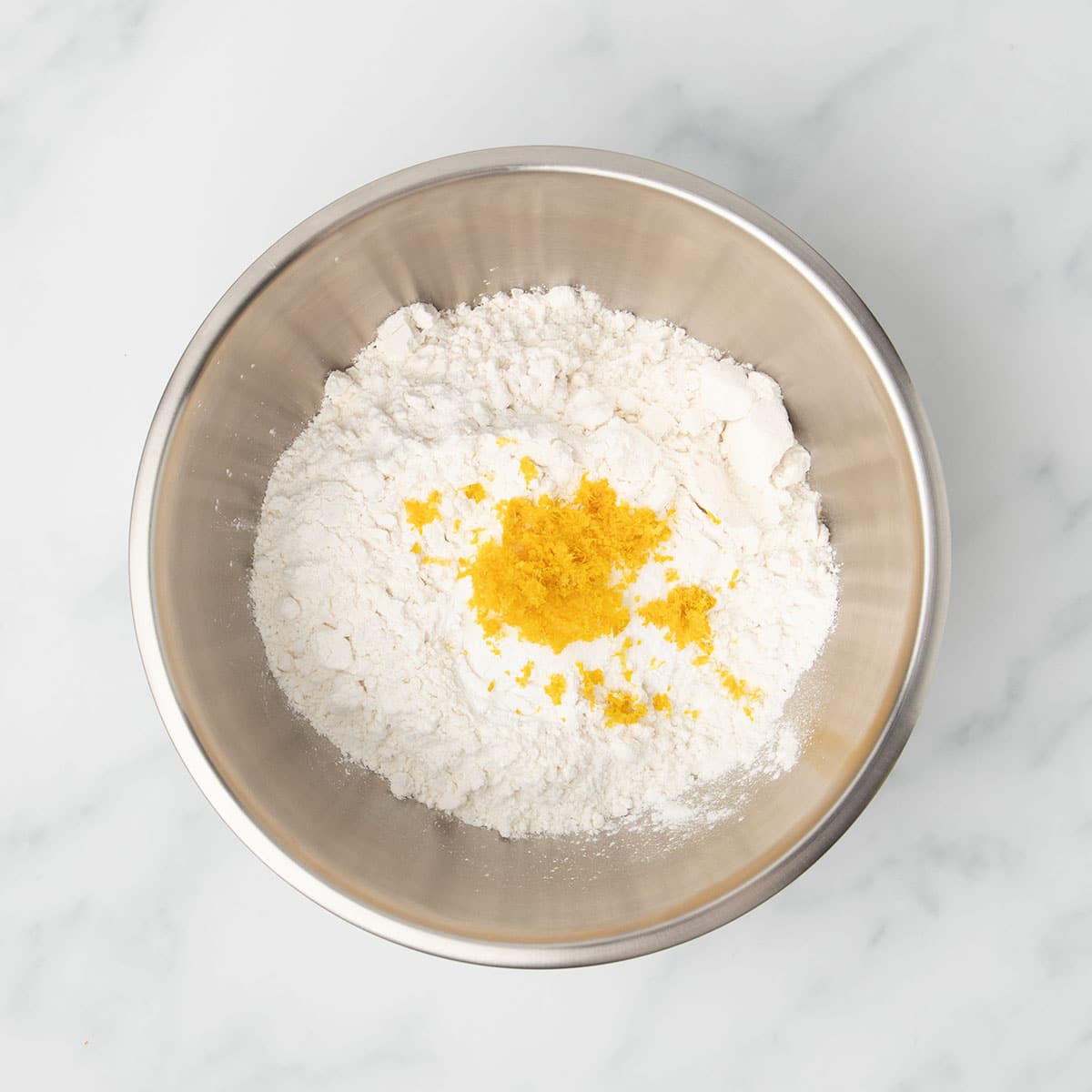
- Whisk the dry ingredients (gluten free flour blend (with xanthan gum), baking powder, baking soda, salt, and plenty of lemon zest).
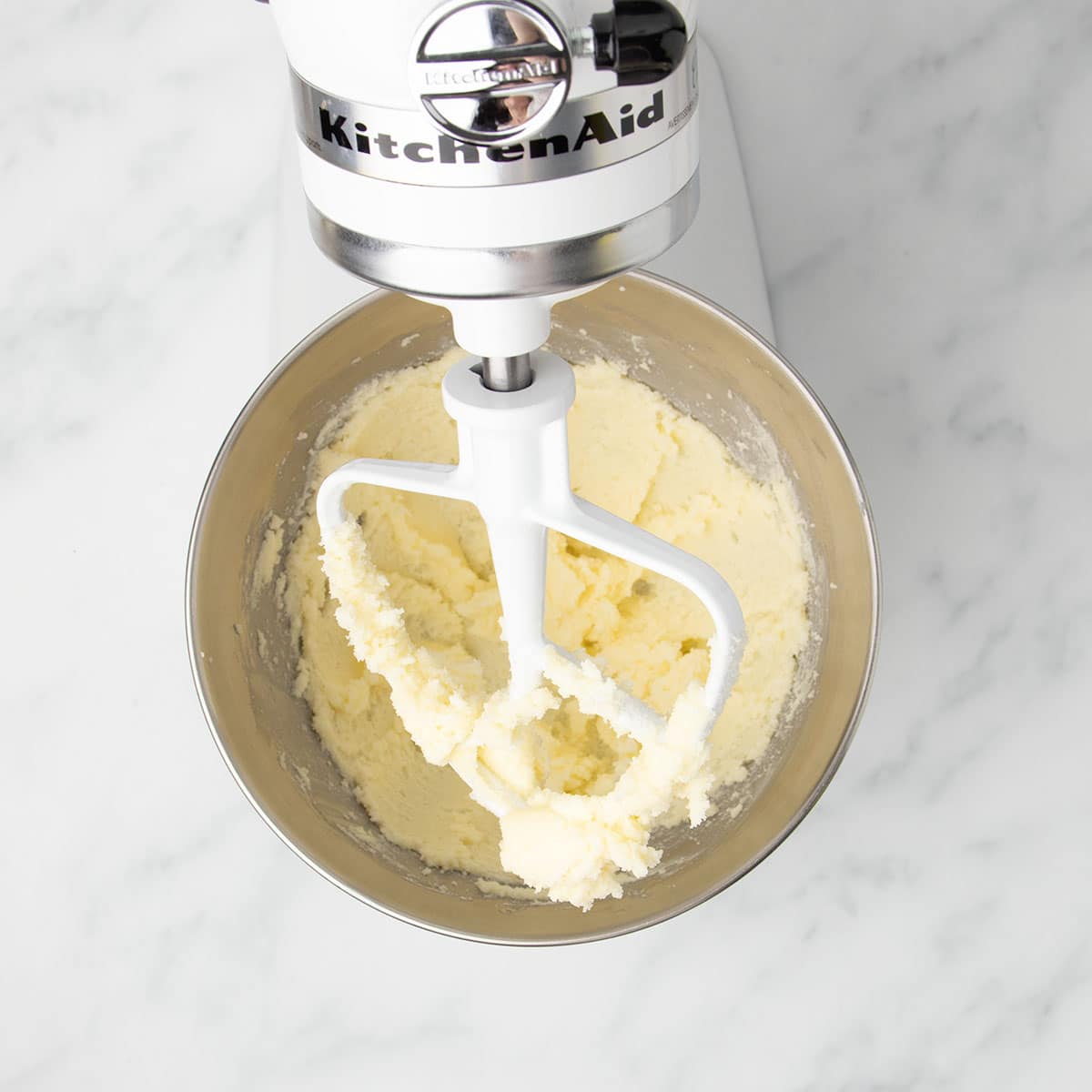
- Cream together the butter and sugar first, to incorporate air that will create an open, tender crumb in the oven.
- Add the egg, egg whites, and vanilla, and beat to combine.
- Mix together the milk and 3 tablespoons of freshly-squeezed lemon juice.
- To the mixing bowl, add the dry ingredients in 3 batches and the milk mixture in 2 batches, alternating between the wet ingredients and the dry ingredients. Beating just to combine after each addition.
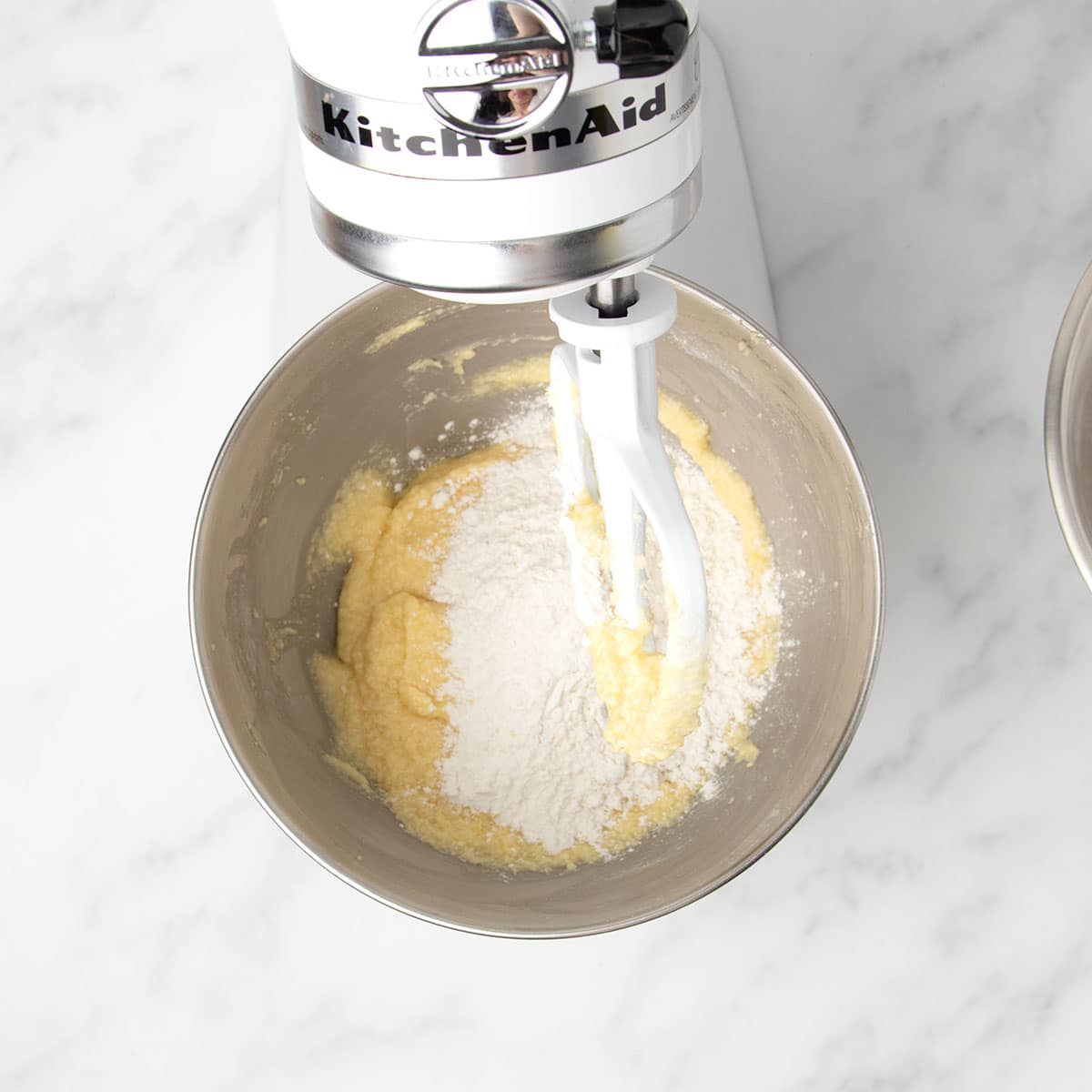
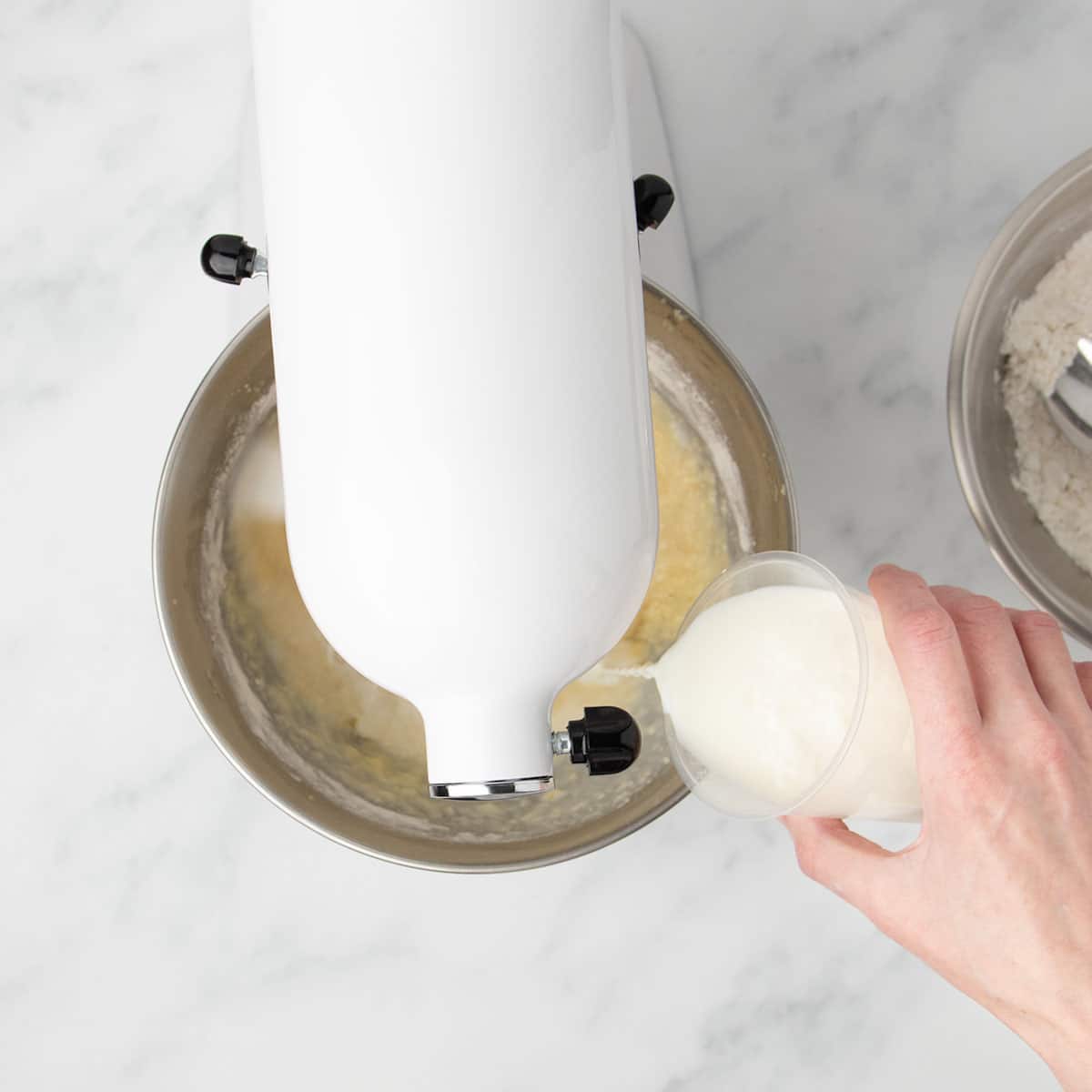
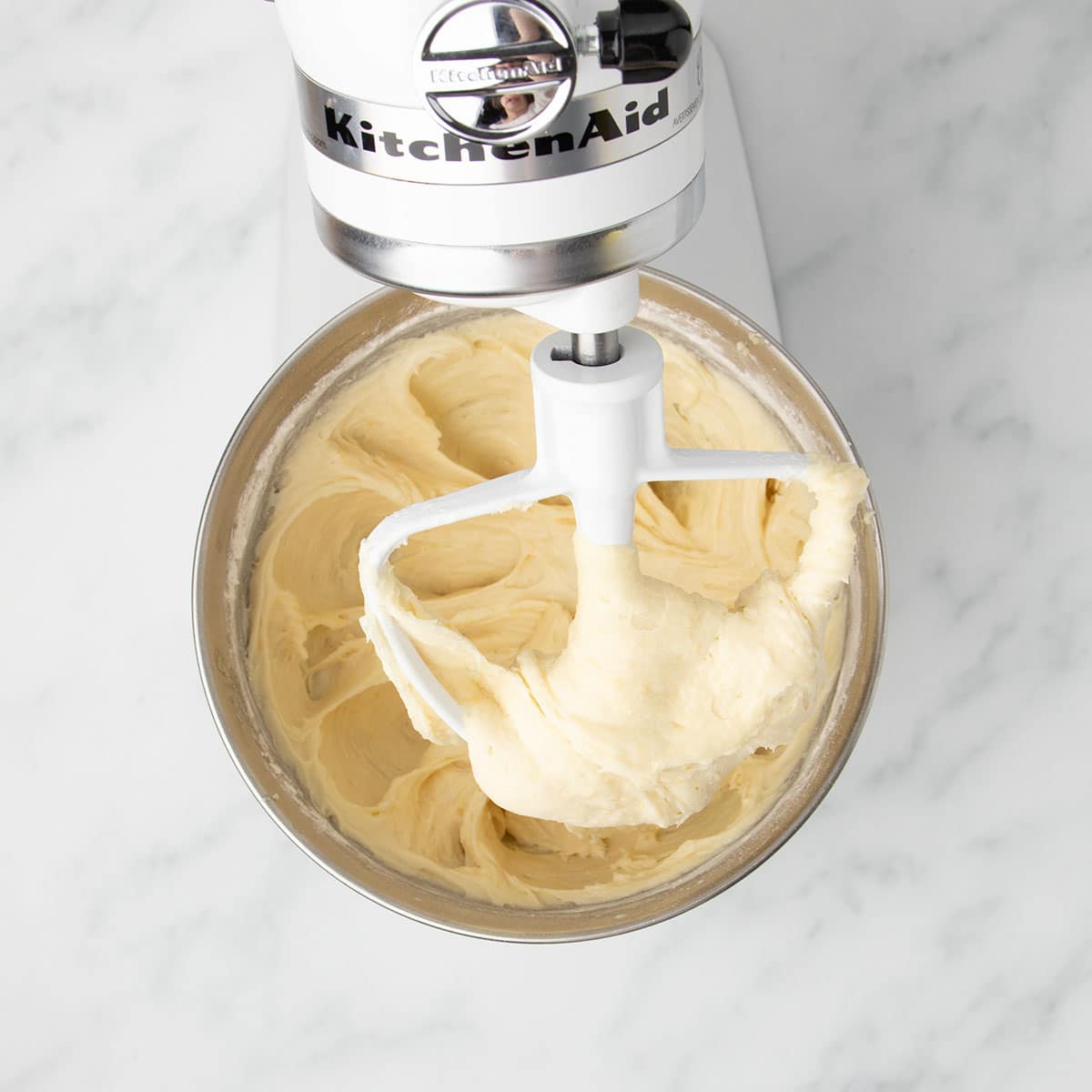
- The cake batter will be fluffy, but pretty thick.
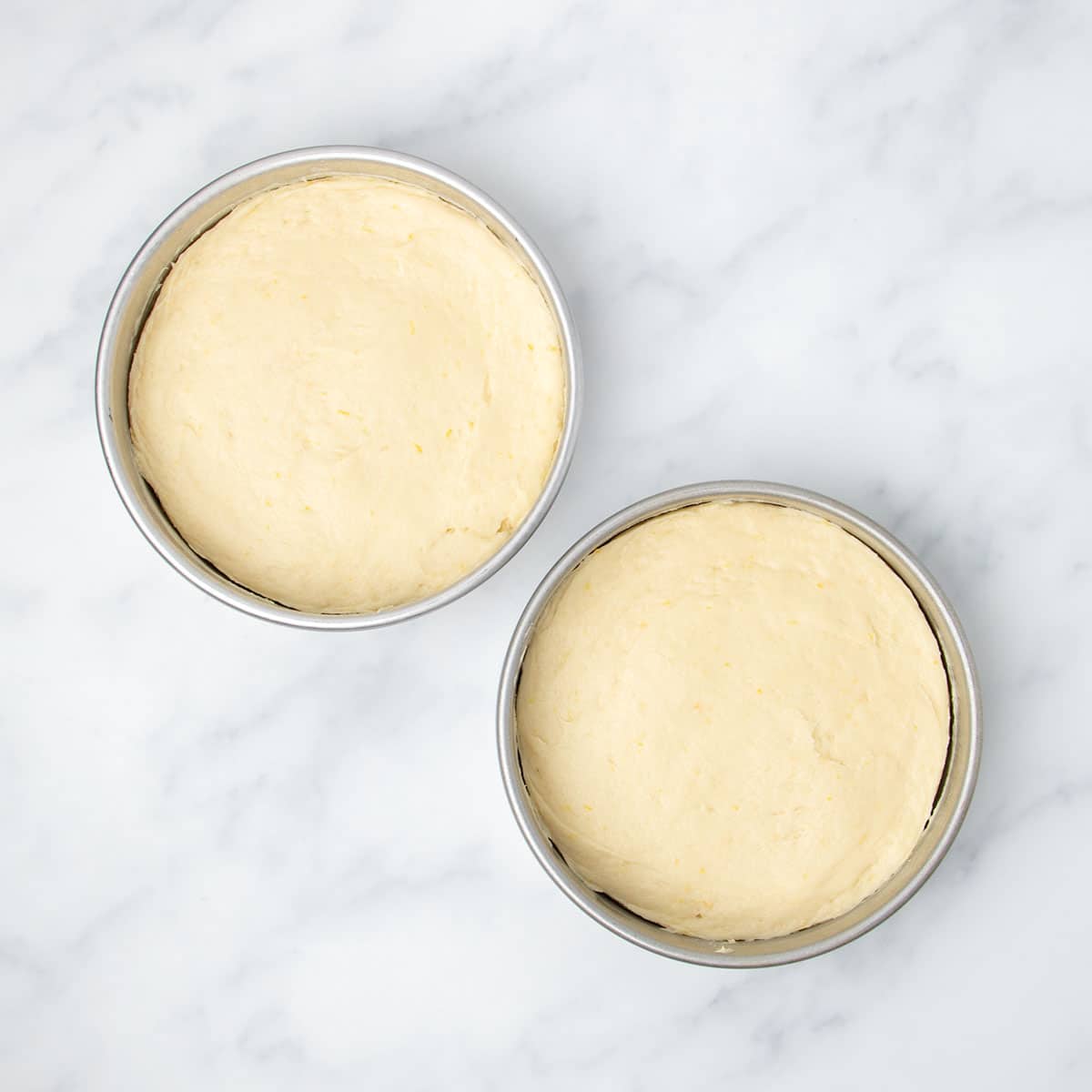
- Divide the batter between the two round cake pans that you've greased well, and smooth the tops.
- Bake at 350°F or until a toothpick comes out mostly clean (and not wet).
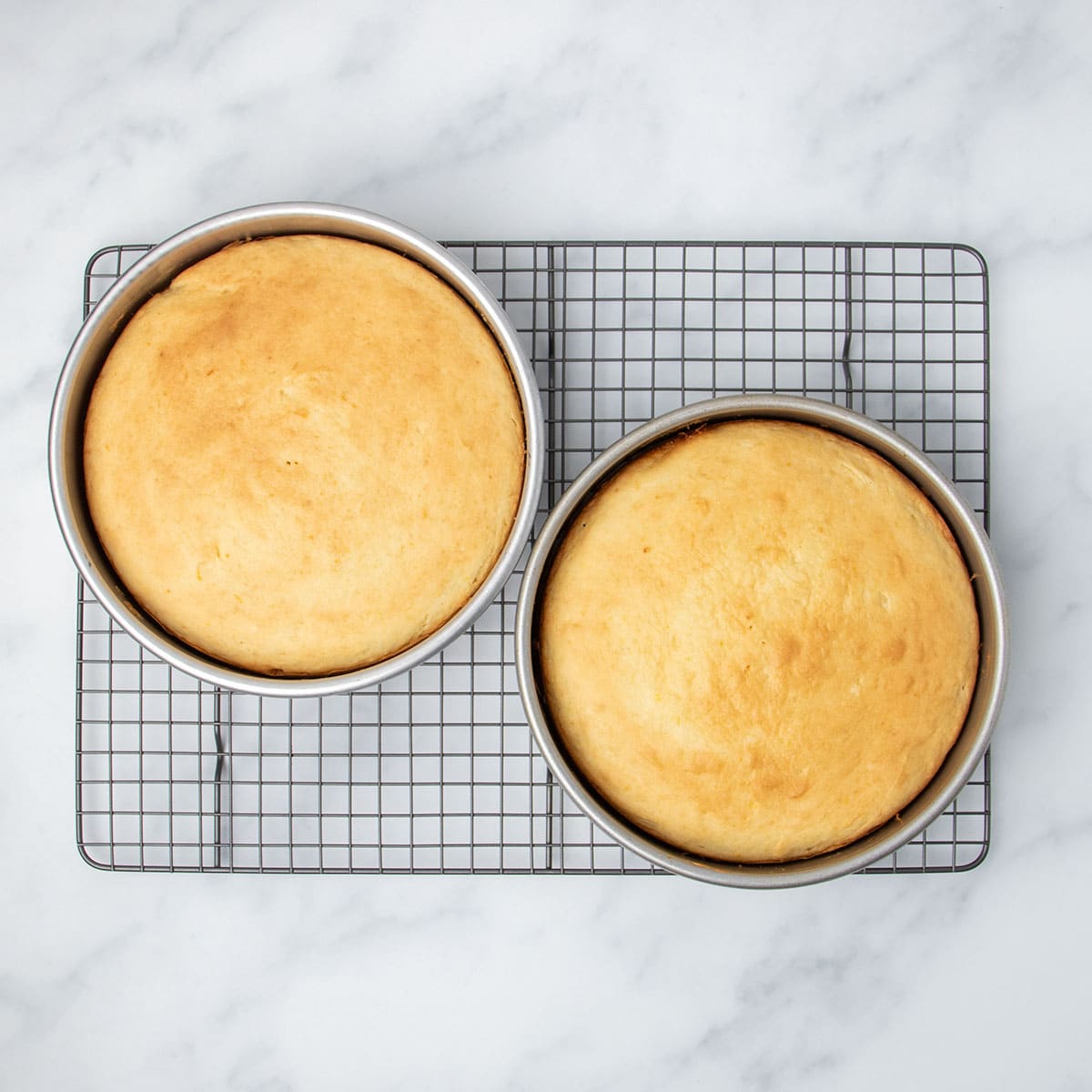
- Let the cakes cool for a few minutes, then turn over onto a wire rack and remove pans.
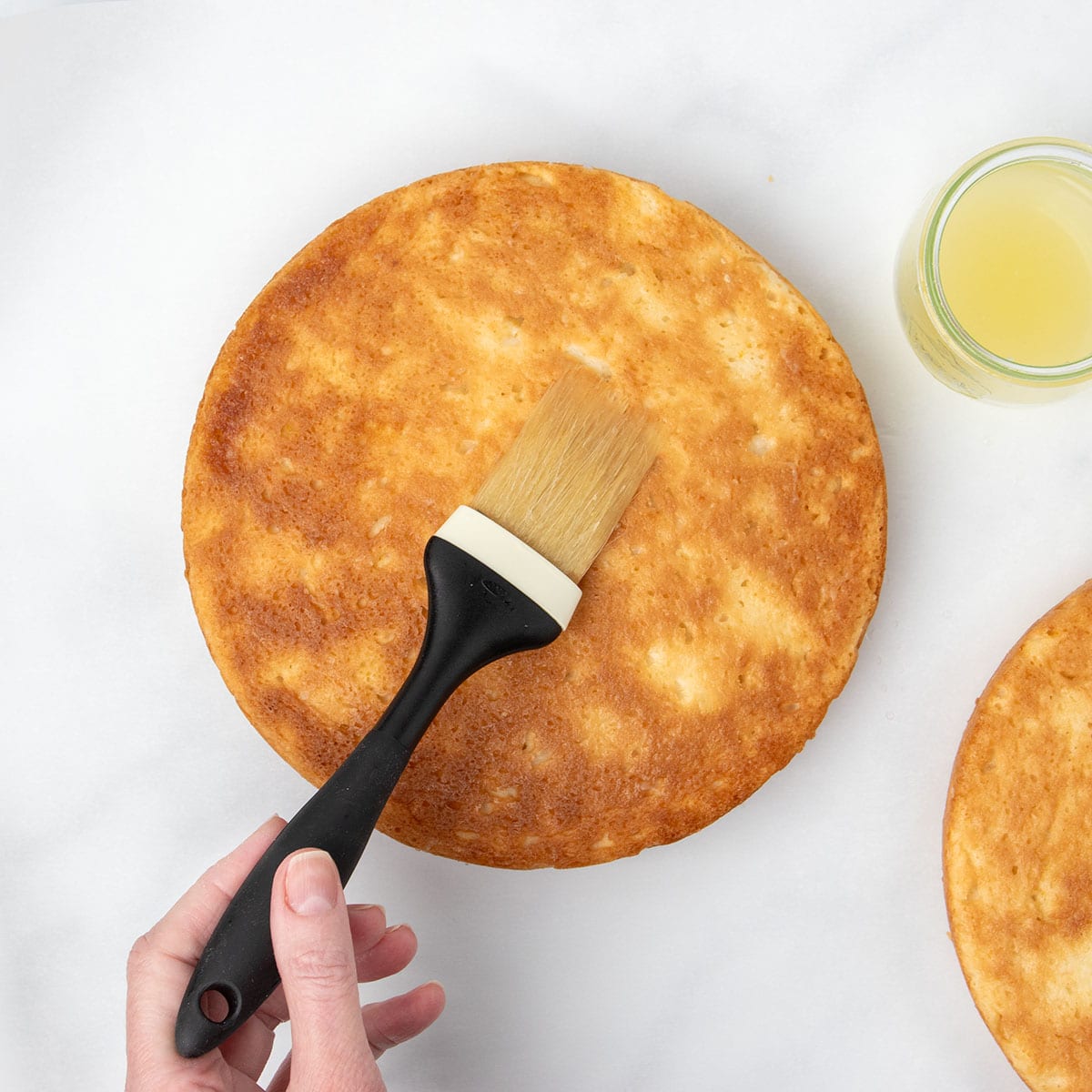
- Brush the bottoms of cakes with 1 tablespoon lemon juice each while still slightly warm.
Make the lemon cream filling/frosting
This is essentially a cream cheese frosting, not a classic buttercream frosting, but it's even softer than a cream cheese frosting because it's made with whipped cream as a base.
Beat softened cream cheese and butter together with confectioners' sugar like a cream cheese frosting, but then fold in fresh whipped heavy cream. Add lemon juice and lemon zest for that bright tangy lemon flavor.
Assemble the cake
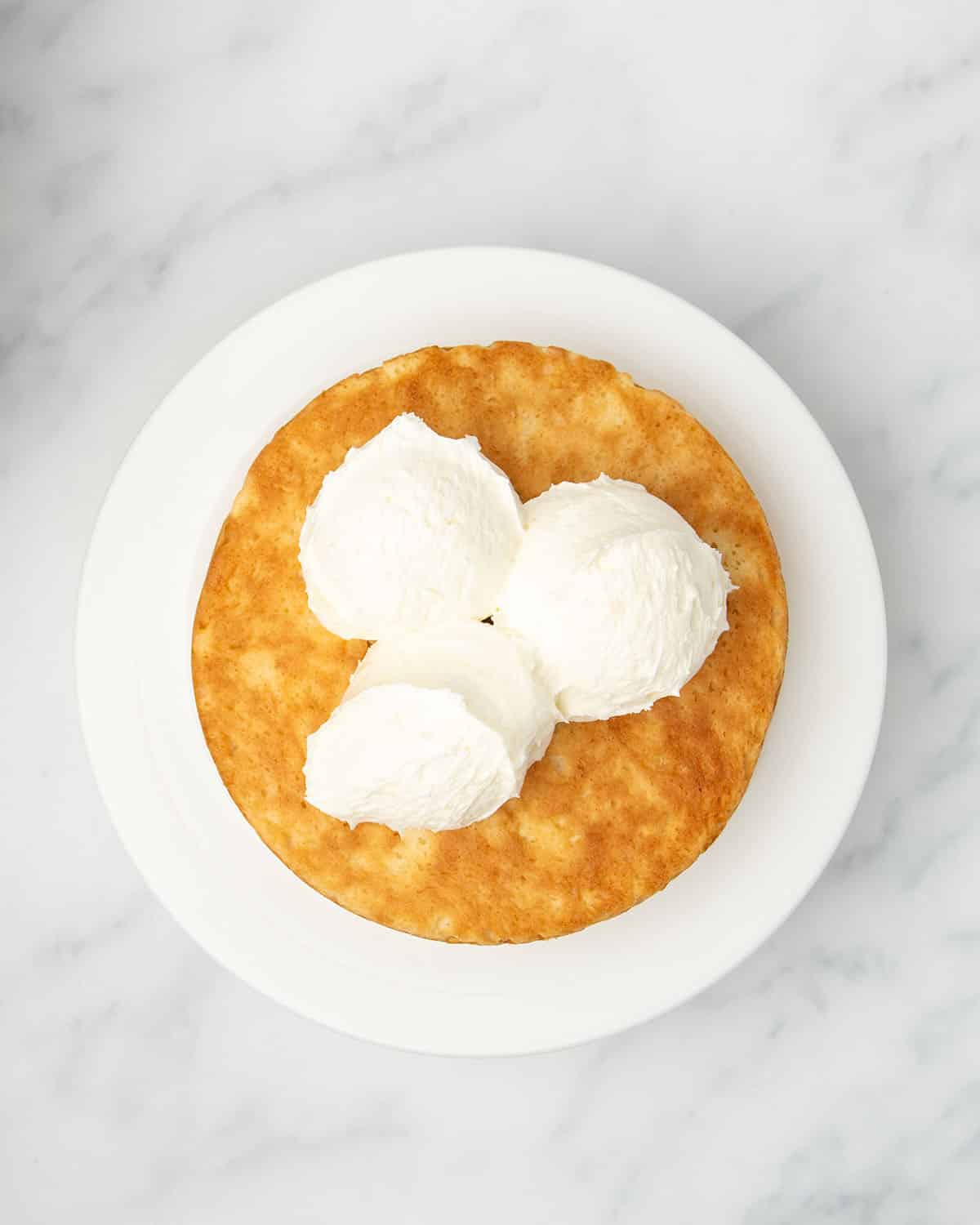
Like any other layer cake, we begin by turning one of the cooled round lemon cakes on a cake plate or other serving platter and adding about half of the prepared lemon cream filling/frosting on top. Spread the filling all the way to the edges, and then top with the other cake, inverted (so the top of the layer cake is flat).
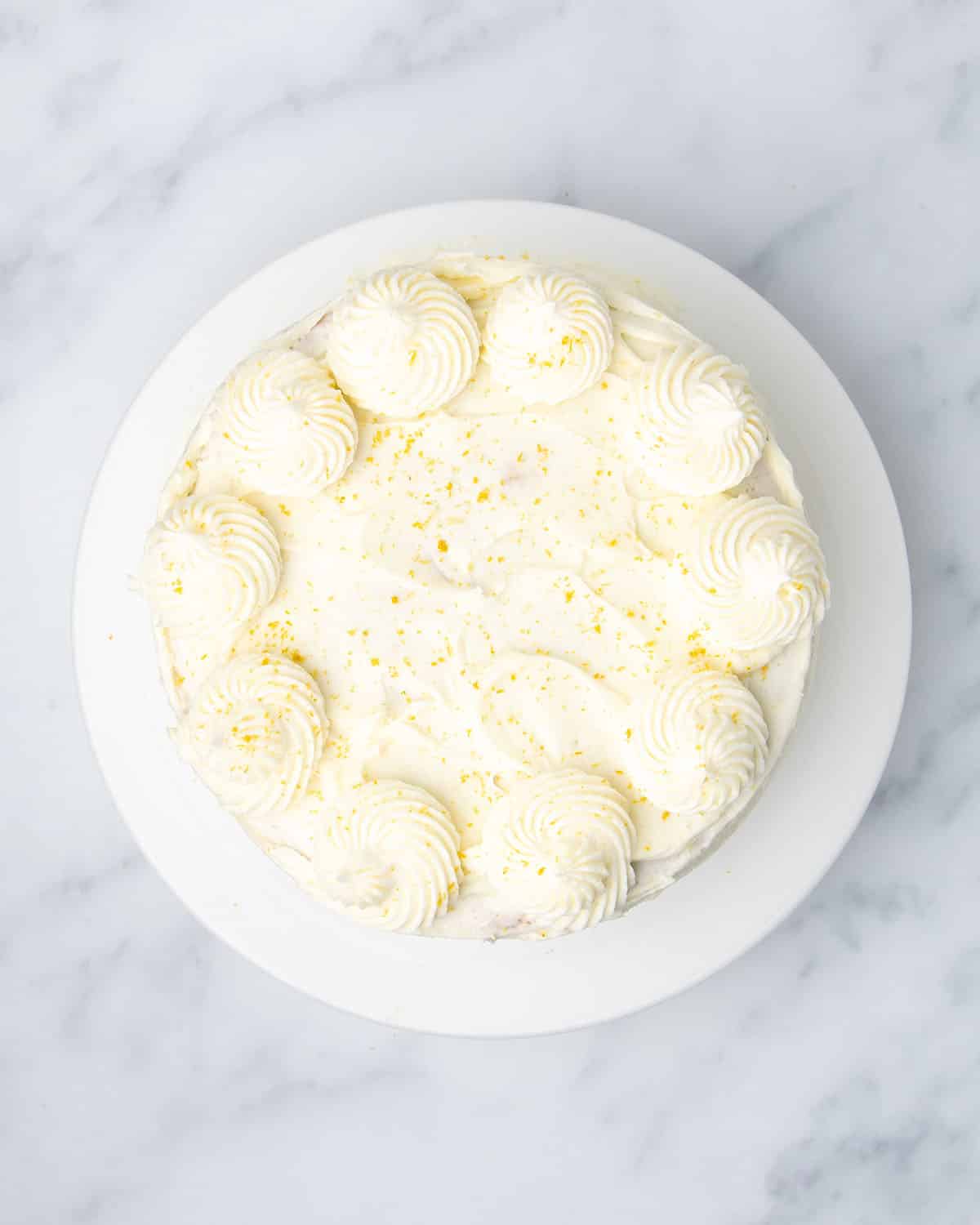
Frost all around the sides and top with the remaining filling, and then add the optional crumbled topping to the top and sides of the cake. Press in the crumbles so they adhere. Slice and serve!
Ingredient substitutions
Dairy free
There is dairy in this recipe in a few forms: milk and butter in the cake, butter in the cream filling/frosting, and cream cheese and heavy whipping cream in the filling. I have suggestions for how to replace all of it with non-dairy alternatives—even the frosting.
For the butter in all cases, I highly recommend a vegan butter alternative. Melt and Miyoko's Creamery brands are my favorites.
For the milk, any nondairy milk will work. Even water works here, but milk with some fat makes for a richer, more tender result.
For the cream cheese, Miyoko's Creamery has a block vegan cream cheese which tastes really good. Tofutti also makes a dairy free cream cheese that's good, but quite soft. You'll need more confectioners' sugar to get it to firm enough to use, but it tastes great.
Egg free
This recipe calls for 1 whole egg and 3 egg whites so that it's only made yellow by the lemon. Otherwise, it tends to be a lot darker yellow. If you'd prefer, you can use 2 whole eggs + 1 egg white instead.
For the whole egg, try replacing it with one “chia egg” or a “flax egg” (although the flax egg will add a competing flavor). For the egg whites, try using an equal amount, by weight, of aquafaba (the brine in a can of unsalted chickpeas).
Gluten Free Lemon Cake Recipe
Equipment
- Stand mixer fitted with paddle attachment or handheld mixer and large mixing bowl
- 2 8-inch round cake pans
- Lemon zester
Ingredients
For the cakes
- 2 ½ cups (350 g) all purpose gluten free flour blend, (See Recipe Notes)
- ¾ teaspoon xanthan gum, omit if your blend already contains it
- 2 teaspoons baking powder
- ¾ teaspoon baking soda
- ¾ teaspoon kosher salt
- Finely grated zest of 1 lemon, at least 1 tablespoon
- 12 tablespoons (168 g) unsalted butter, at room temperature
- 1 cup (200 g) granulated sugar
- 1 (50 g (weighed out of shell)) large egg, at room temperature, beaten
- 3 (75 g) egg whites, at room temperature
- 2 teaspoons pure vanilla extract
- 1 cup milk, at room temperature
- 3 tablespoons freshly squeezed lemon juice, for the cake batter, at room temperature
- 2 tablespoons freshly squeezed lemon juice, for brushing
For the optional crumb topping
- ½ cup (70 g) all purpose gluten free flour blend, any of my recommended blends will work
- ⅛ teaspoon xanthan gum, omit if your blend already contains it
- ½ cup (58 g) confectioners’ sugar
- ⅛ teaspoon kosher salt
- 4 tablespoons (56 g) unsalted butter, melted
- ½ teaspoon pure vanilla extract
- 2 tablespoons (1 fluid ounce) freshly squeezed lemon juice
For the lemon cream filling/frosting
- 1 ½ cups (12 fluid ounces) heavy whipping cream, chilled
- 8 ounces (1 package) cream cheese, at room temperature
- 5 tablespoons (70 g) unsalted butter, at room temperature
- ¼ teaspoon kosher salt
- 4 cups (460 g) confectioners’ sugar, sifted
- 2 tablespoons freshly squeezed lemon juice
- Finely grated zest of 1 lemon
For assembling
- 1 teaspoon finely grated lemon zest, for sprinkling (optional)
Instructions
- Preheat your oven to 350°F. Grease two 8-inch round baking pans and set them aside.
First, make the cakes
- In a large bowl, place the flour blend, xanthan gum, baking powder, baking soda, salt, and lemon zest, and whisk to combine well. Break up any lumps in the lemon zest.
- In the bowl of a stand mixer fitted with the paddle attachment or a large bowl with a hand mixer, place the butter and sugar, and beat on medium-high speed until light and fluffy (about 3 minutes).
- Add the egg, egg whites, and vanilla, and beat on medium-high speed until well-combined.
- Add 3 tablespoons of lemon juice to the milk, and mix to combine.
- Add the dry ingredients and the milk mixture, alternating between the dry ingredients and milk, and beginning and ending with the flour. Beat on medium speed to combine after each addition. The batter will be fluffy but rather thick.
- Divide the cake batter evenly among the two prepared cake pans and spread it into an even layer in each.
- Place in the center of the preheated oven and bake, rotating once, until a toothpick inserted into the center comes out with a few moist crumbs attached (about 25 minutes).
- Remove the cakes from the oven and allow to cool in the pans for 10 minutes before inverting onto wire racks to finish cooling.
- Once the cakes are on the wire rack, while they're still warm, use a pastry brush to paint the bottom of each cake with one of the remaining 2 tablespoons of lemon juice.
Make the (optional) crumb topping
- While the cakes finish cooling, make the optional crumble topping.
- Place the flour and confectioners’ sugar in a medium-size bowl and whisk to combine well. Add the butter, vanilla and lemon juice and mix to combine. The dough will be thick.
- Place the dough between two small sheets of unbleached parchment paper and roll out into a rectangle about 1/4-inch thick.
- Remove the top sheet of parchment paper and transfer the dough still on the bottom sheet of parchment to a small rimmed baking sheet.
- Place in the center of the preheated oven and bake for 7 minutes, or until just beginning to brown on the edges.
- Remove from the oven and allow to cool on the baking sheet for about 10 minutes before breaking and crumbling into small pieces. Set aside.
Make the lemon cream filling/frosting
- In the bowl of a stand mixer fitted with the whisk attachment or a large bowl with a hand mixer, place the heavy whipping cream and beat on medium-high speed until stiff peaks form (about 5 minutes).
- Scrape the whipped cream into a separate bowl and place it in the refrigerator to chill.
- In the same mixer bowl, place the cream cheese and butter and beat (with the paddle attachment if using a stand mixer) until light and fluffy (about 3 minutes).
- Add the salt and confectioners’ sugar, and beat on low speed until the sugar is absorbed into the cream cheese-butter mixture.
- Add the lemon juice and lemon zest, turn the mixer up to high speed and continue to beat until the frosting is light and fluffy (about 3 more minutes).
- Remove the whipped cream from the refrigerator and fold it into the cream cheese frosting.
Assemble the cake
- Place one of the cooled 8-inch cakes, still upside down, in the center of a serving platter.
- Place about one-half of the lemon cream filling on top.
- Spread into an even layer all the way up to the edge of the cake, and top with the other cooled 8-inch cake, still upside down.
- Brush the exposed side of the top cake with lemon juice and cover the whole cake, top and sides, with a very thin layer of the filling.
- Cover with the remaining filling on the top and as much of the sides as you like.
- Sprinkle the top and sides of the cake with the optional crumb topping, pressing the crumbs gently into the frosting/filling to adhere.
- Chill the cake for 10 minutes to make slicing and serving easier.
Video
Tell Google you trust GFOAS!
Notes
Nutrition
Nutrition information is automatically calculated, so should only be used as an approximation.
Frosting options
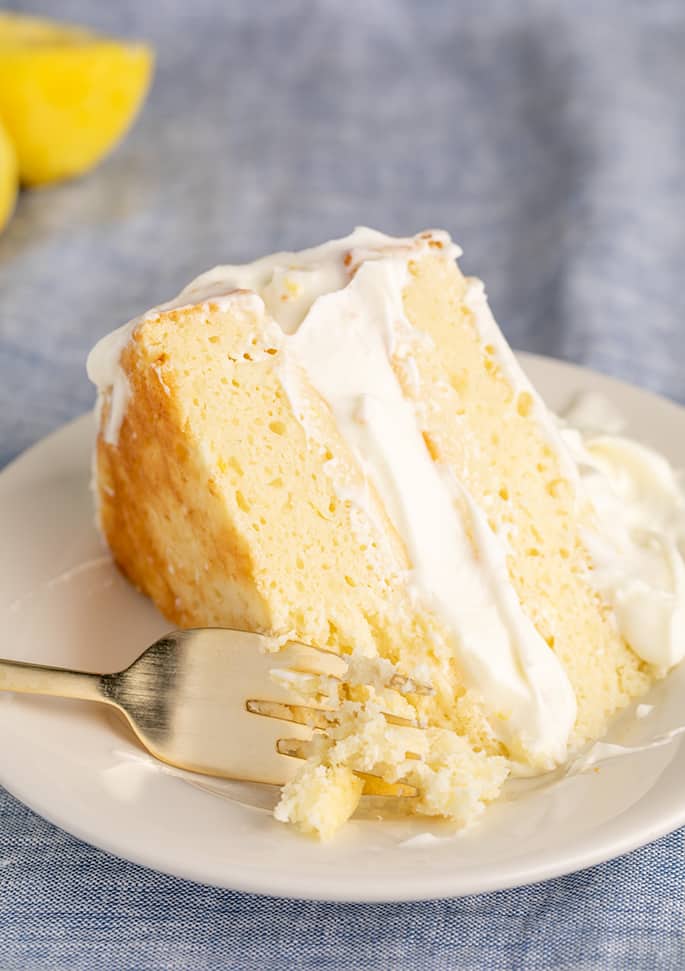
The cake has quite a bit of lemon flavor, so you don't have to serve it with the lemon cream just to ensure that it tastes, well, like lemon cake. There are other options for frosting or even icing that taste great with this cake.
Swiss meringue buttercream
You can't ever go wrong with a Swiss meringue buttercream. The quick, foolproof recipe I use and recommend is by SugarHero. She doesn't cook the sugar, which makes everything a snap! You can also add some lemon zest to it, or lemon extract.
How to make a simple lemon icing
You can always make a simple glaze to pour over each individual slice, or the whole cake. Place 1 cup (115 g) confectioners’ sugar in a medium-size bowl and add about 1 1/2 teaspoons of freshly squeezed lemon juice (or water).
Mix until you have a very smooth, thick paste. Add more lemon juice until you have a very thickly pourable glaze.
Add the liquid slowly, because it’s much easier to thin it than to thicken if once you’ve added too much liquid. Pour or spoon the glaze over the cooled cake or each slice before serving.
How to make buttercream frosting
Here's how to make enough frosting for a 2 layer cake like this gluten free lemon cake:
- Classic vanilla buttercream: Beat 16 tablespoons (224 g) unsalted butter, at room temperature until light and fluffy. Add 4 cups (460 grams) sifted confectioners’ sugar, 1/8 teaspoon kosher salt, 1/4 teaspoon pure vanilla extract, and beat until well-combined. Add milk by the teaspoonful, at room temperature, until the . That will make about 4 cups of buttercream, just enough for a layer cake.
- Lemon buttercream: The same as vanilla buttercream, but add 1 teaspoon of fresh lemon juice in place of vanilla extract and 1 teaspoon of lemon zest.
- Cream cheese frosting: Same as vanilla buttercream, but instead of 16 tablespoons room temperature unsalted butter, use 8 more tablespoons unsalted butter and 8 ounces of cream cheese, at room temperature. You will need 1/2 to 1 cup more confectioners' sugar to make the frosting as firm as it would be with all butter.
leftovers/make ahead
Make ahead & storage instructions
Make ahead
I usually make the undecorated round lemon cakes ahead of time. Just let them cool completely after brushing with lemon juice, wrap tightly, and freeze, and then defrost at room temperature before serving. Don't refrigerate the cakes, though, as the refrigerator tends to be drying.
If you do make the crumb topping, it can be made ahead, too. Just store it covered at room temperature for a day, or wrapped very tightly and frozen for weeks, and allow it to come to room temperature before serving.
The cream filling is quite a bit softer than a traditional buttercream frosting, so I really don't like to fill and frost the cake until the day I plan to serve it. Cream cheese frosting is softer than all butter frosting, and folding in whipped cream softens it further.
Assemble the cake soon before you serve it, and if you store it in the refrigerator be sure to allow it to sit at room temperature for at least 30 minutes before serving. Cakes made with butter taste dry when cold.
Storing leftover cake
If you have leftovers, I recommend wrapping each slice individually in a freezer-safe wrap like Glad Press n Seal. Don't press the wrap firmly onto the frosting but cinch it closed tightly.
Freeze in a single layer on a baking sheet, then place in a freezer-safe bag until ready to serve. It will keep in the freezer for up to 3 months if you squeeze all the air out of the bag.
Defrosting frozen slices
You can't microwave frozen cake, because the frosting will melt into a puddle. Let each slice defrost, still wrapped tightly, at room temperature. It will defrost within about 1 hour.

FAQs
When cakes rise in the oven and then fall as they cool, they're not baked all the way through. Your oven may be running too hot, which browned the outside of the cake too quickly, long before the center had a chance to bake enough to hold its shape as the steam escaped. Next time, use a standalone oven thermometer since most ovens run hot, and bake for longer.
I haven't tried making these as cupcakes, but it might work. You can usually make cupcakes into cake and cake into cupcakes, but you won't always get the best version of either.
Of course! Just follow the instructions as written, but you'll need to reduce the baking time because baking in a larger pan means that there is more of the batter exposed to the heat of the oven at all times. Start to check the cakes at about 22 minutes.
Sure! You can use lime zest in place of lemon zest, and lime juice in place of lemon juice. Same goes for orange.










Question — if you make the crumb topping ahead and freeze it — do you freeze it before you crumble it?
I’m afraid I’ve never tried that, Pam, and I honestly don’t know whether it would work!
Hi, do you have any recommendations for using silicon pans with this recipe? I’d like to use my silicon 4” heart pan but is the cake dense enough to hold its shape coming out of the mold?
Hi, JM, I don’t bake in or on silicone since it has a lot of vulnerabilities, so it’s really hard for me to say and unfortunately you’d have to experiment. If you do try, I’d recommend placing the pan on a metal baking sheet for stability. Silicone does hold heat well and it doesn’t breathe, so you’ll need to find a balance between letting the cake cool enough that it’s stable before turning it out, and making sure it doesn’t sweat in the pan which will make the cake chewy and make it shrink. I hope that helps!
This gluten-free lemon cream cake looks absolutely amazing — I love how moist and bright it sounds.