

This post may contain affiliate links. Please read our disclosure policy.
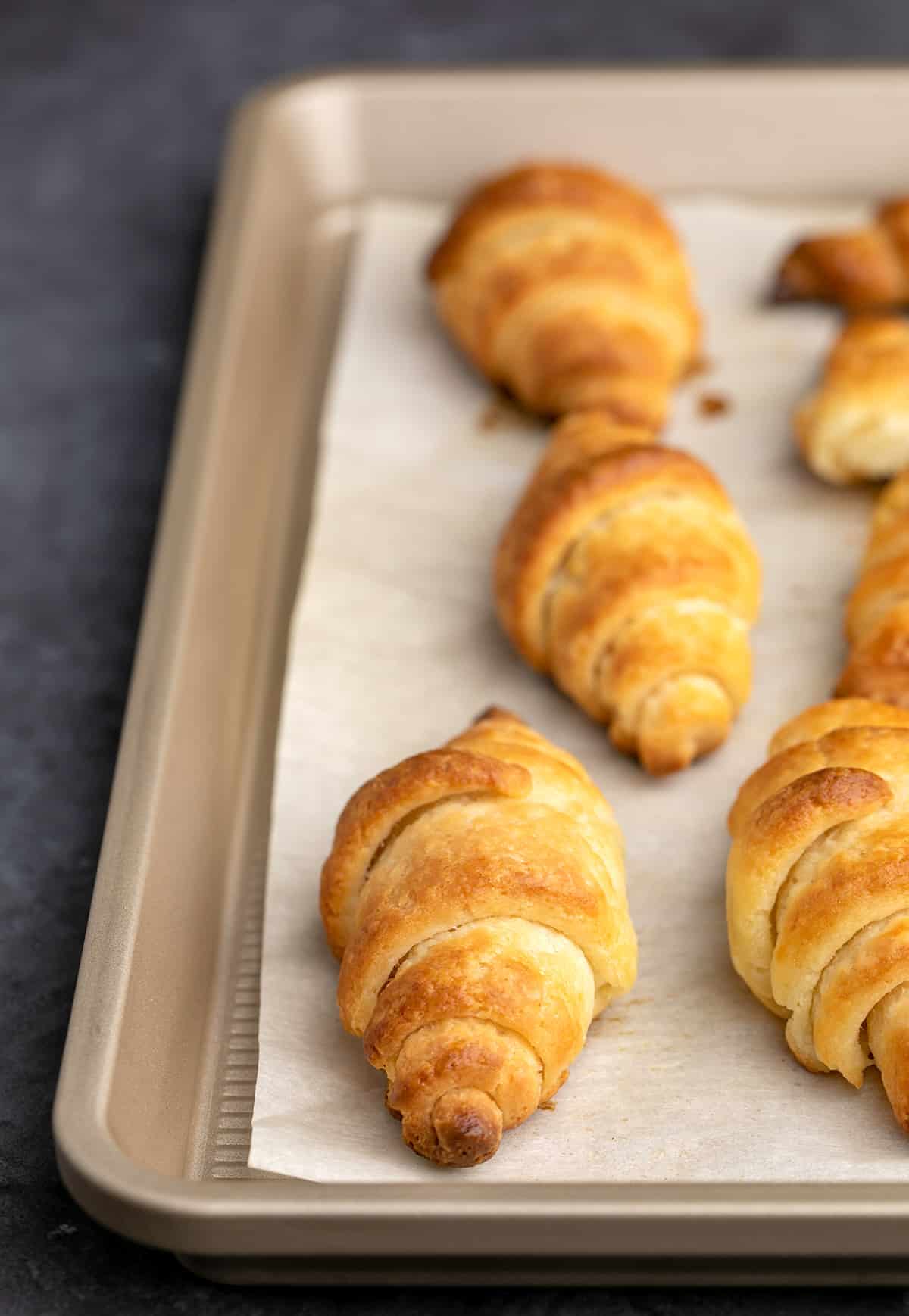
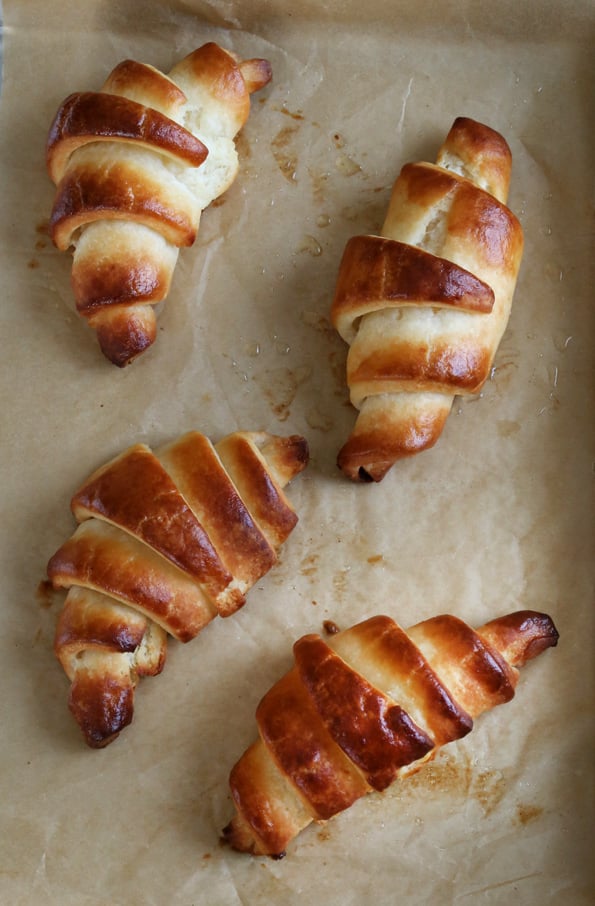
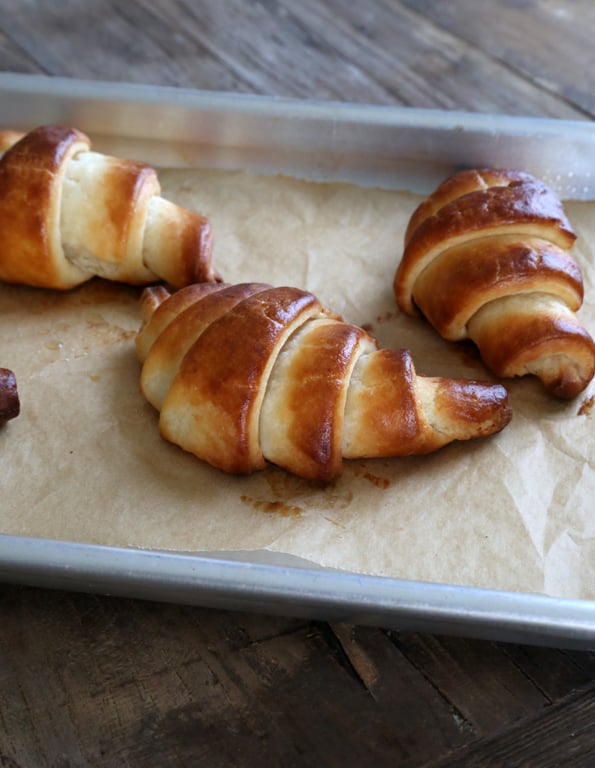
If you have ever wondered if you could make a gluten free croissant at home—whether you could really do it—this recipe is the proof that you can do it. You should do it. Here's how, step by step.

Why this recipe works
These croissants have that melt-in-your-mouth flakiness that seems intimidating, but they’re actually quite simple to make. The amount of information in the recipe card and the step-by-step photos here is not because it’s hard to make these beautiful pastries happen. It’s because it can be hard to imagine what it's like to make them, but once you see it done and the concept clicks, they're really simple to make (although they do take some time).
Believe it or not, traditional gluten free croissants are one of the most common recipes requests I have received over all the years of writing this blog. It’s not like it’s every day that I’m positively buried with requests from readers simply dying to make their own croissants, though.
It’s more like a steady drip-drip-drip of requests over the years. Over time I’ve mostly pointed readers in the direction of an old custard-filled danish recipe from years ago, since danishes are made from yeasted puff pastry, which is really what croissant dough is.
I’ve also suggested to readers that they just use my recipe for gluten free puff pastry (no yeast involved), and call it a day. After all, that's a delicious recipe that makes really flaky gf pastries.

The secret to making a perfect gluten free croissant
Traditional croissants are, indeed, made with what is essentially a yeasted puff pastry dough, making these the most delicate and flaky of pastries as they get lift both from yeast and from “laminated” dough (lamination is simply the process by which you encase layer after layer of cold butter in layer after layer of pastry dough). That’s the only time you’ll hear any “fancy” terms, though, in this whole business. Period full stop.
Read through the instructions below, stare at the step-by-step photos, and watch the video. Follow the temperature instructions to the letter (sometimes ingredients and doughs are room temperature, sometimes (usually) they’re cold), and remember that pastry dough is much less a matter of chemistry than it is a matter of architecture.
Layers and layers of butter surrounded by layers and layers of gluten free flour. The yeast gives these an extra lift over puff pastry, but really the general puff pastry architecture is what does the heavy-lifting of creating the flakiness we crave.
Think of it like this: unlike flour, butter expands as it warms. When the butter layers (created in the “turns” described below) are properly chilled, they hit the heat of the oven and puff up, forcing the flour layers up and out.
Recipe ingredients
- Gluten free pastry flour – For this easy gluten free croissant recipe, you need a pastry flour, which you can easily make yourself by combining Better Batter all purpose flour, cornstarch, and dry milk.
- Instant yeast – Yeast is what distinguishes gluten free croissant dough from pastry dough. During a proofing period, it causes your croissants to puff up, revealing all those amazing layers. Here, we use instant yeast, since it doesn't have to be hydrated in liquid first, but can be whisked right into the dry ingredients. If you only have active dry yeast, you'll need 25% more of it, by weight, and to let it proof first in some of the milk.
- Sugar – There's only a little sugar in this gluten free croissant recipe to “feed” the yeast.
- Salt – Salt is a must to complement the intense buttery flavor, and to control the yeast.
- Butter – This is the star of the show. It's what gives you that incredible flavor and mouthfeel, but as the gf croissants bakes, it's also what releases steam for maximum flakiness.
- Milk – This is the liquid that brings the gluten free croissant dough together.
- Eggs – We only need one egg for this gf croissant recipe, to brush on before baking, so you can achieve a rich, golden brown crust.
Equipment needed
- Large mixing bowl
- Rolling pin
- Parchment paper
- Plastic wrap
- Pastry cutter or pizza cutter
- Baking sheets
- Basting brush
Expert tips
Don't rush the process
It's takes time to make croissants, and if you try to rush the process by skipping the several refrigeration steps or reducing the number of turns, they won't turn out.
The first time you decide to make gluten free croissant rolls, set aside a weekend. Give yourself plenty of time to get familiar with the preparation steps and practice, practice, practice. It's the only way you'll build the confidence and skill to do these right.
Splurge on the butter packet
I would argue that the butter packet is the star of this show, so I highly suggest trying a European-style butter which is made with more fat, so it's so incredibly rich and flavorful.
Envision shaping the croissants
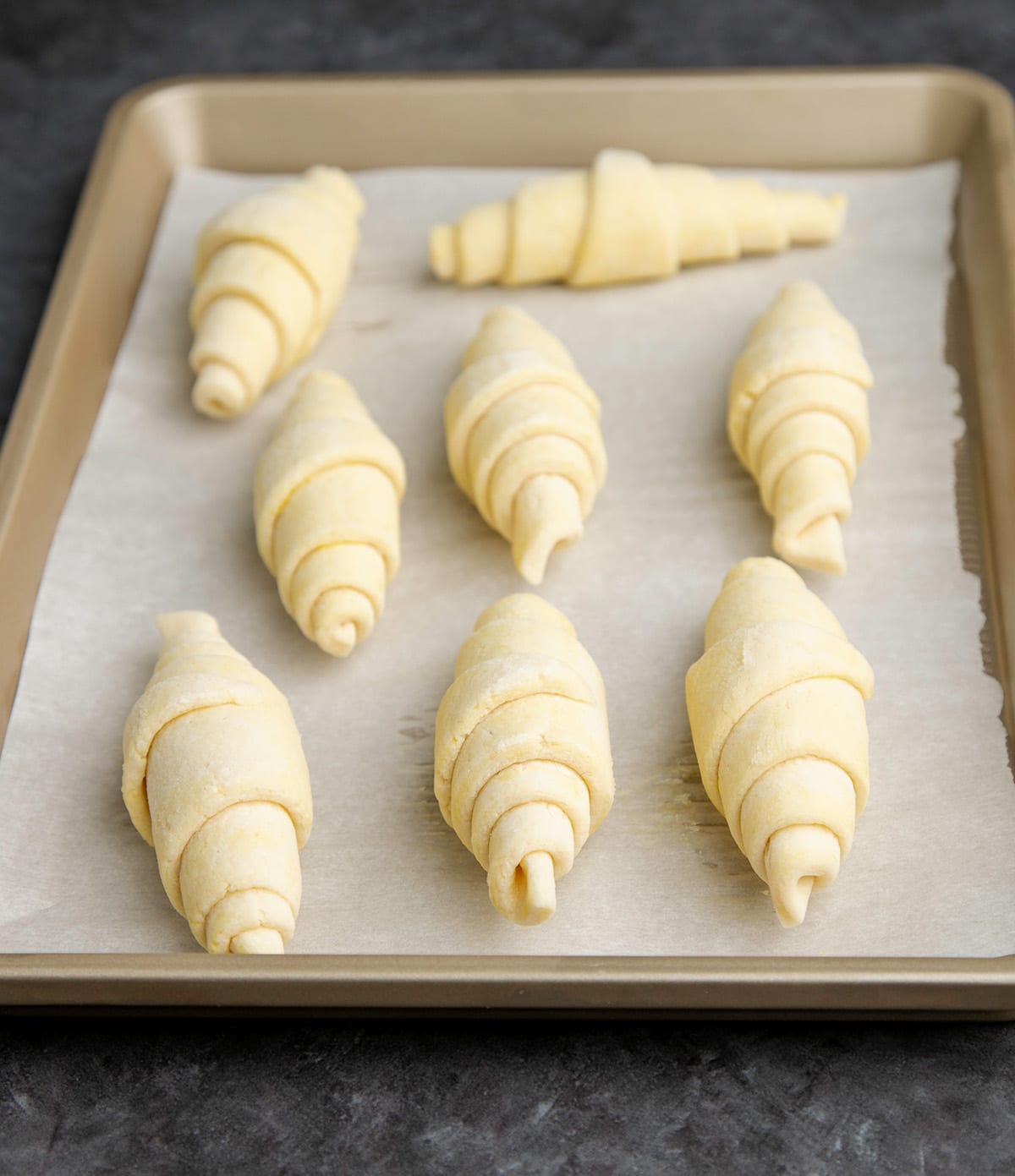
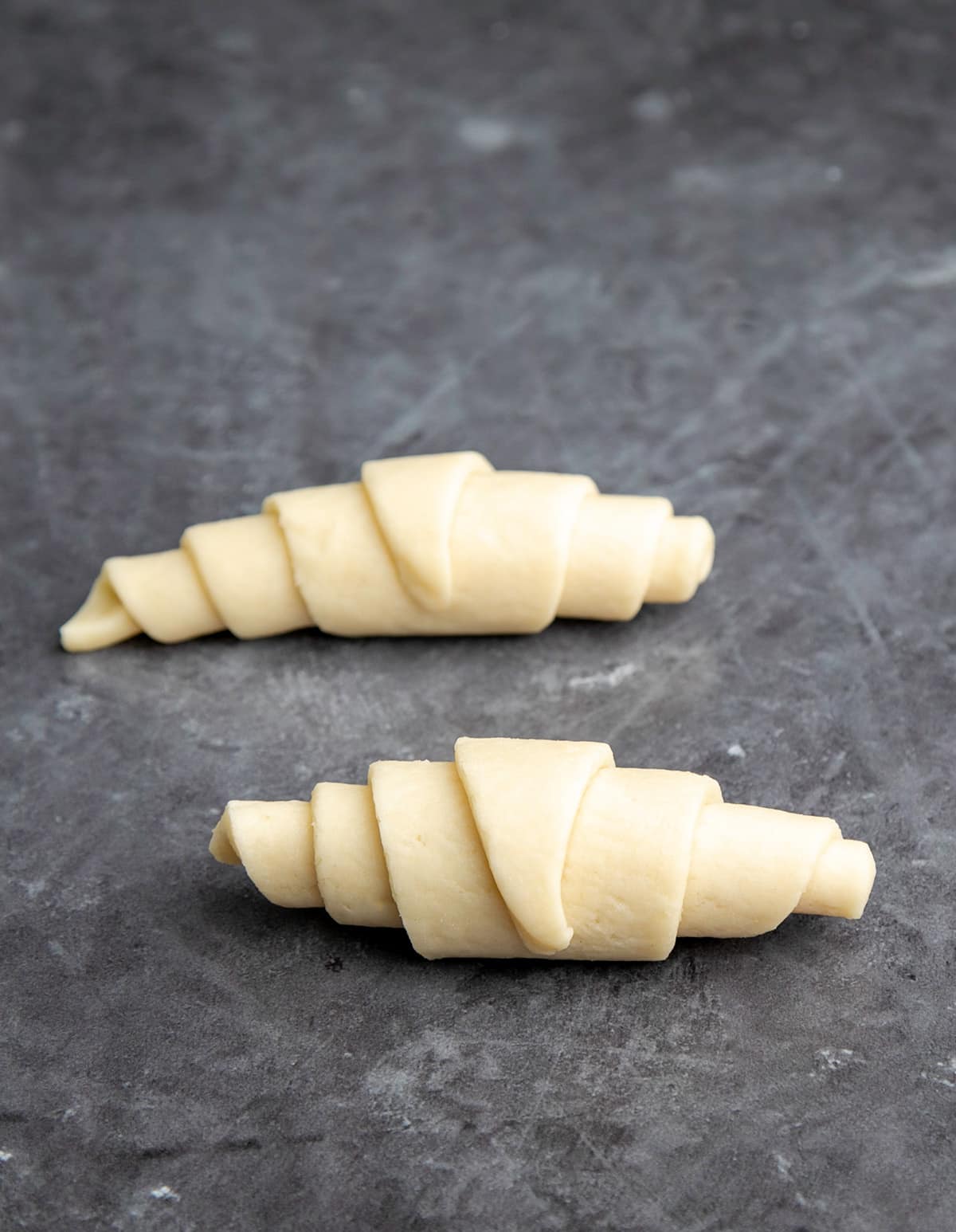
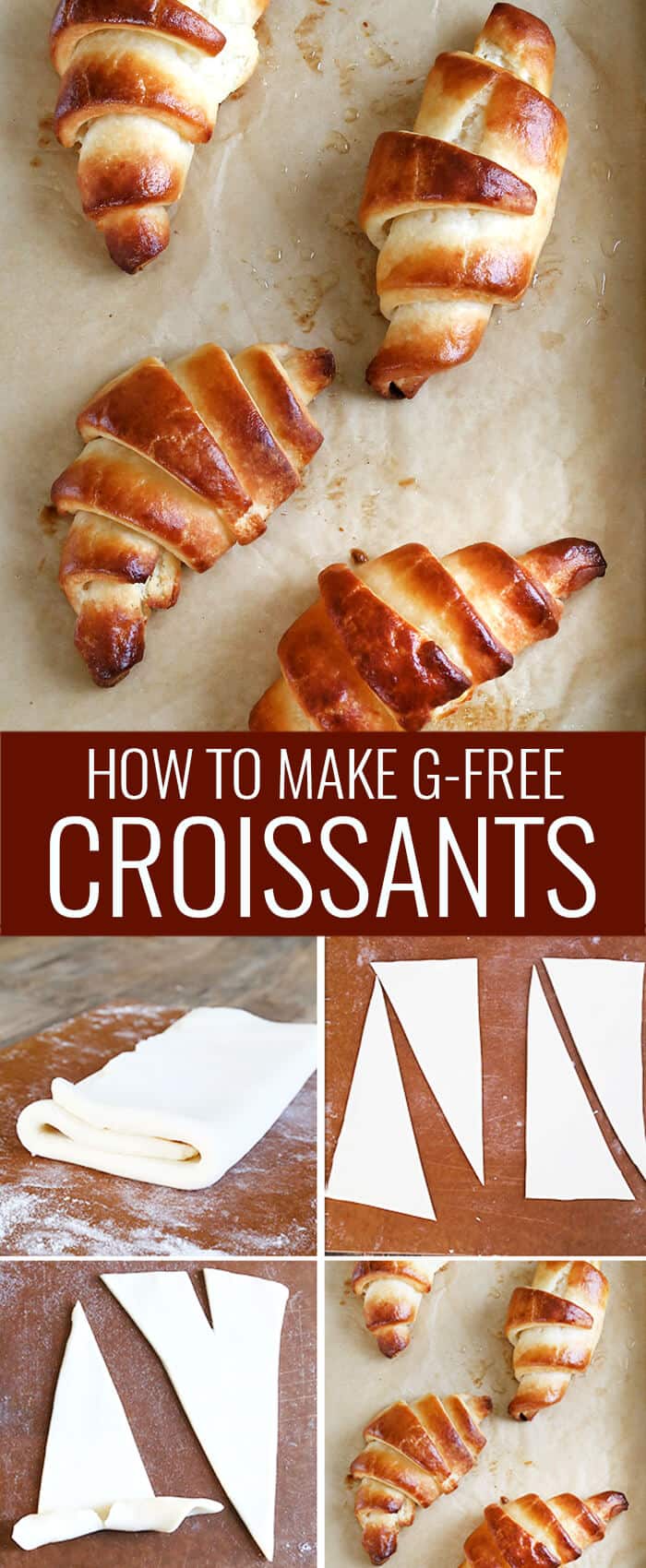
Once you've rolled out your dough a final time, cut out equally sized rectangles. Then, slice the rectangles diagonally to create long triangles using a pastry wheel, pizza cutter or very sharp knife. You need a sharp tool as crisp lines help maintain definition.
Then, put a small slit at the widest part of the triangle, and then roll the croissants up from the base, just slightly turning the edges away from each other as you go.
Chill the dough whenever necessary
Butter is the star of the show, and although we begin working with it while it's cold, we have to work with solid at room temperature, using our hands. The heat from the room and the heat of our hands does tend to warm the butter and cause it to begin to melt. That's why the process calls for handling the butter and the dough, and then refrigerating it until it's solid again before proceeding.
There may be times when you notice signs that the butter is melting, but the recipe doesn't yet call for refrigeration. The dough may become sticky or difficult to handle. Whenever this happens, refrigerate the dough, then pick up where you left off afterward.
Storage suggestions
Baked gluten free croissants can sit at room temperature in an airtight container, and they'll stay fresh for two to three days.
Note that the longer they sit, the more they'll harden and go stale. If you get to that point, you can quickly refresh a gluten free croissant to restore softness by popping it into the microwave for 10 to 15 seconds.
Freeze for longer storage
For longer storage, make sure the baked pastries are completely cool. Place them on a baking sheet, and pop the whole thing into the freezer. When the croissants are mostly frozen, you can transfer them to a freezer safe, ziptop bag. They'll stay good for a couple of months.
To defrost, you can leave the croissants on the counter or in the fridge, and then bake them for a few minutes at 350°F until they're heated through.
Ingredient substitutions
Dairy free
There's quite a bit of dairy in this gluten free croissants recipe. There's the dry milk in the gluten free pastry flour blend, the liquid milk for combining the dough, and of course, the butter.
In place of dry milk, you can try using a substitute like coconut milk powder or soy milk powder. Soy milk tends to toughen baked goods, though, so I'd be more inclined to try the coconut milk powder.
You can use a dairy free milk of your choice in place of the liquid milk. Almond milk or coconut milk will probably work fine.
For the butter, you can likely substitute your favorite vegan butter. My favorite brand is Melt, and when I can't find that, I go with Earth Balance.
Egg free
We only use egg as a wash prior to baking these gluten free croissants. It helps create a gorgeous golden-brown crust, but if you can't have eggs, you can easily use melted butter or melted vegan butter in its place.
Vegan
For gluten free, vegan croissants, you'll want to follow all of my suggestions above for replacing the dairy and eggs.
Recipe variations
There aren't a lot of variation options when it comes to traditional gluten free croissants, but there is one you'll likely be interested to know about.
And that would be gluten free pain au chocolat — gluten free chocolate croissants. A gluten free chocolate croissant recipe is exactly the same as the traditional croissants recipe, except before you roll your triangles, you drop a few small pieces of chocolate onto the dough.
Bake as instructed, and you'll enjoy crispy, flaky croissants with a center of rich, melted chocolate.
FAQs
The biggest difference between gluten free croissant dough and gluten free puff pastry is that the first uses yeast and the second doesn't.
Preparation of the two is very similar with the butter packets and the laminating, but adding yeast gives croissants a puffier, flaky consistency.
No, croissants are the not same as crescent rolls. Although a croissant and a crescent roll may look similar and both contain yeast, croissants require a lamination process that creates alternating layers of flour and cold butter that create flaky pastry layers during baking. Crescent rolls are shaped enriched yeast bread, made with warm ingredients. Try our recipe for gluten free crescent rolls to taste the difference.
Laminating may sound technical, but it just describes the process of folding a butter packet into dough. It's not a hard process at all, but the method is specific and essential if you want all the flaky layers for which croissants are known.
Yes, you can double this gf croissant recipe, but I don't recommend it if you're making them for the first time. There's a bit of an art of making the best gluten free croissants, and it's much easier if you aren't working with double the amount of dough. Begin by reading the recipe all the way through to the end, gathering your ingredients, and following the recipe exactly as written.
Gluten Free Croissant Recipe | Buttery, Flaky, and Simple!

Equipment
- Rolling Pin
- Pizza wheel or pastry wheel, for slicing/shaping
Ingredients
For the dough
- 2 ¼ cups (315 g) gluten free pastry flour, (See Recipe Notes)
- 2 teaspoons (6 g) instant yeast
- 2 tablespoons (24 g) granulated sugar
- 1 teaspoon (6 g) kosher salt
- 3 tablespoons (42 g) unsalted butter, melted and cooled
- ¾ cup (6 fluid ounces) whole milk, at room temperature
For the butter packet
- 16 tablespoons (224 g) unsalted butter, chilled
- ¼ cup (36 g) gluten free pastry flour, (See Recipe Notes)
- Egg wash, (1 egg + 1 tablespoon water, beaten well), for brushing
Instructions
Make the dough
- In a large bowl, place the flour, yeast and sugar, and whisk to combine well. Add the salt, and whisk again to combine.
- Create a well in the center of the dry ingredients, add the butter and milk, and mix until the dough comes together.
- Add more flour by the half-teaspoonful if necessary to bring the dough together.
- Turn out the dough onto a lightly floured surface, sprinkle the top very lightly with more flour, and roll into a 9-inch round.
- Wrap tightly in plastic wrap and place in the refrigerator to chill while you prepare the butter packet.
Prepare the butter packet
- Sprinkle a piece of unbleached parchment paper with 1/8 cup (2 tablespoons) of the flour, and place all 16 tablespoons (preferably in 2 whole sticks) of butter on top and press together.
- Sprinkle with the remaining 2 tablespoons of flour, and cover with another piece of unbleached parchment paper.
- Pound the butter with a rolling pin until it flattens and melds together.
- Uncover and fold the flattened butter in half, cover again with the parchment and pound again until you have a 5-inch square butter packet.
- Cover the butter packet completely with parchment, and place in the refrigerator to chill for 5 minutes or until firm.
Wrap the dough around the butter packet
- Remove the 9-inch round dough from the refrigerator, unwrap it, and place it on a lightly floured surface.
- Place the chilled butter packet directly in the center of the dough and score the sides of the dough lightly to represent the exact size of the butter. Remove the butter and set it aside.
- Using a rolling pin and sprinkling the dough lightly with flour as necessary to prevent it from sticking, begin at the site of each of the four scorings and roll the edges of the dough away from the center to create 4 flaps, leaving the center of the dough intact.
- Return the butter packet to the intact center of the dough, and wrap the flaps of the dough around the butter packet like you would a present.
Roll out the dough with the butter and complete the first “turn”
- Sprinkle the dough-and-butter-packet lightly with more flour, and roll out into a 1/2-inch thick rectangle.
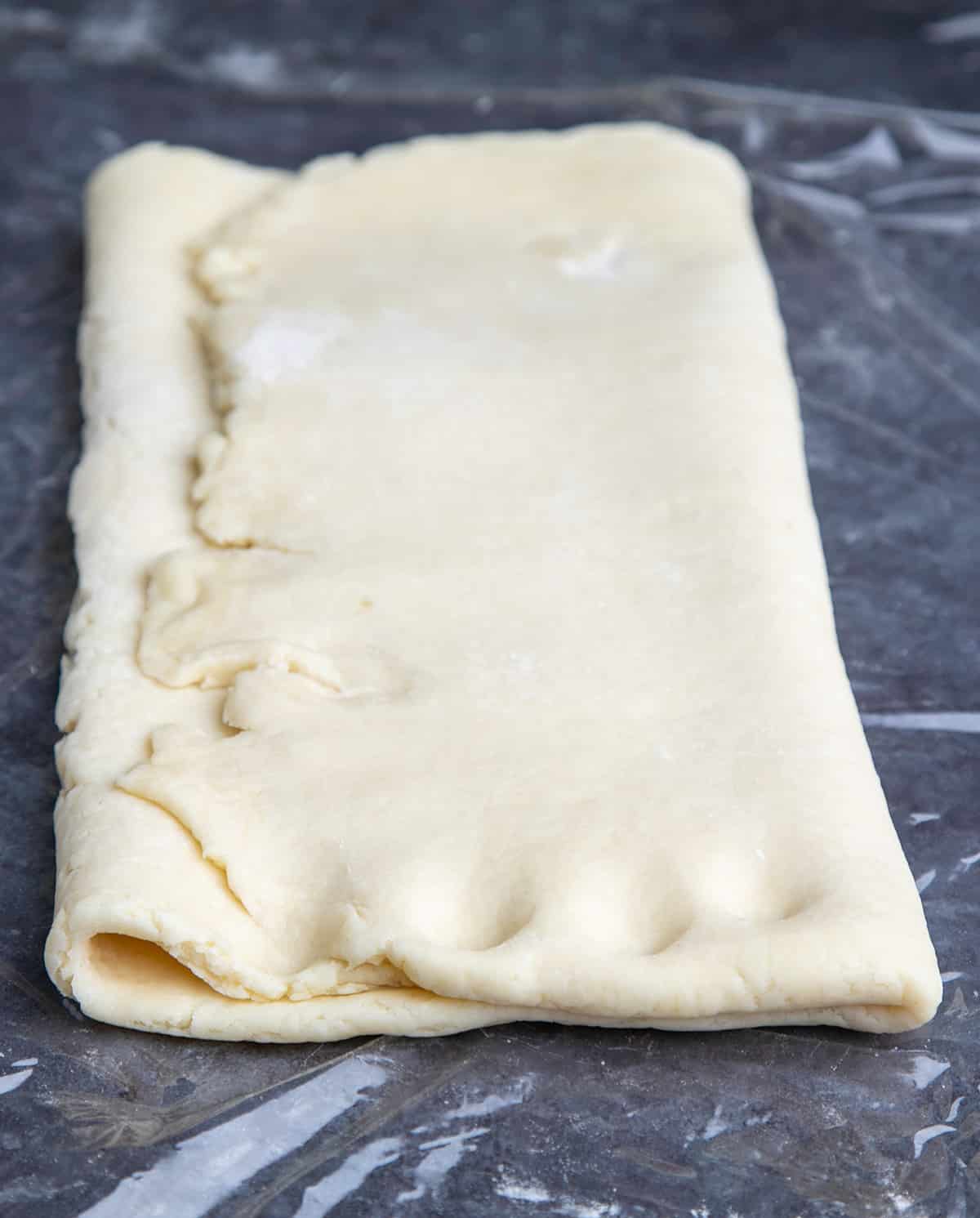
- Fold the rectangle over on itself in thirds, as you would a business letter. Sprinkle the dough again lightly with flour.
- With the length of the 3-layer rectangle of dough running parallel to your body, roll the dough away from you into a rectangle that is again about 1/2-inch thick.
- Turn the left and right sides of the 1/2-inch thick rectangle over on themselves again, as you would a business letter.
- You have just completed the first “turn.” Wrap the folded dough tightly in plastic wrap and place in the refrigerator to chill for at least 4 hours or up to overnight.
Complete the remaining 4 to 5 “turns”
- Once the dough has finished chilling after its first turn, repeat the process of rolling the 3-layer dough out into a 1/2-inch thick rectangle, then refolding the dough like a business letter, at least 4 more times, (for good measure, 5 more times). After each turn, keep track by pressing a notch in the dough with one knuckle to represent the number turn you're on (e.g., after 4 turns, make 4 notches).
- Be sure to wrap and chill the 3-layer rectangle of dough in the refrigerator for at least 30 minutes (or the freezer for 10 minutes) in between turns. If you let the dough chill for too long, it may become difficult to roll out smoothly. Just let it sit at room temperature for a few minutes before rolling it back out.
Shape the croissants
- Line rimmed baking sheets with unbleached parchment paper and set them aside.
- Roll out the prepared 3-layer croissant dough into a 1/4-inch thick rectangle.
- Using a pastry wheel or pizza wheel (or very sharp knife—well-defined edges are essential here), square the edges, then cut out as many 4-inch x 6-inch rectangles as you can.
- Slice each rectangle diagonally into two triangles and separate the shapes from one another.
- Sprinkling lightly with flour as necessary to prevent sticking, roll each triangle out to elongate it to about 8-inches from base to tip.
- Slice a notch into the base of each triangle about 1/2-inch deep, and roll each triangle into a coil from base to tip, turning the edges slightly away from each other as you roll.
- Place on the prepared baking sheets, seam side down, about 2-inches apart from one another.
Proof the croissants
- Cover lightly with oiled plastic wrap and place in a warm, draft-free location until nearly doubled in size. You will see the individual layers in each fold begin to separate slightly from one another once the croissants are fully proofed.
- Uncover the baking sheets and brush the tops and sides of the croissants with the egg wash.
- To avoid gluing the coiled layers of each croissant together, brush with the egg wash by beginning in the center of each pastry and brushing out to the sides in one motion on each side, with the “grain” of each coil, not against.
Chill the proofed croissants
- Place the shaped and proofed croissants in the refrigerator to chill for at least 10 minutes or until mostly firm.
Bake
- While the shaped croissants are chilling, preheat your oven to 400°F.
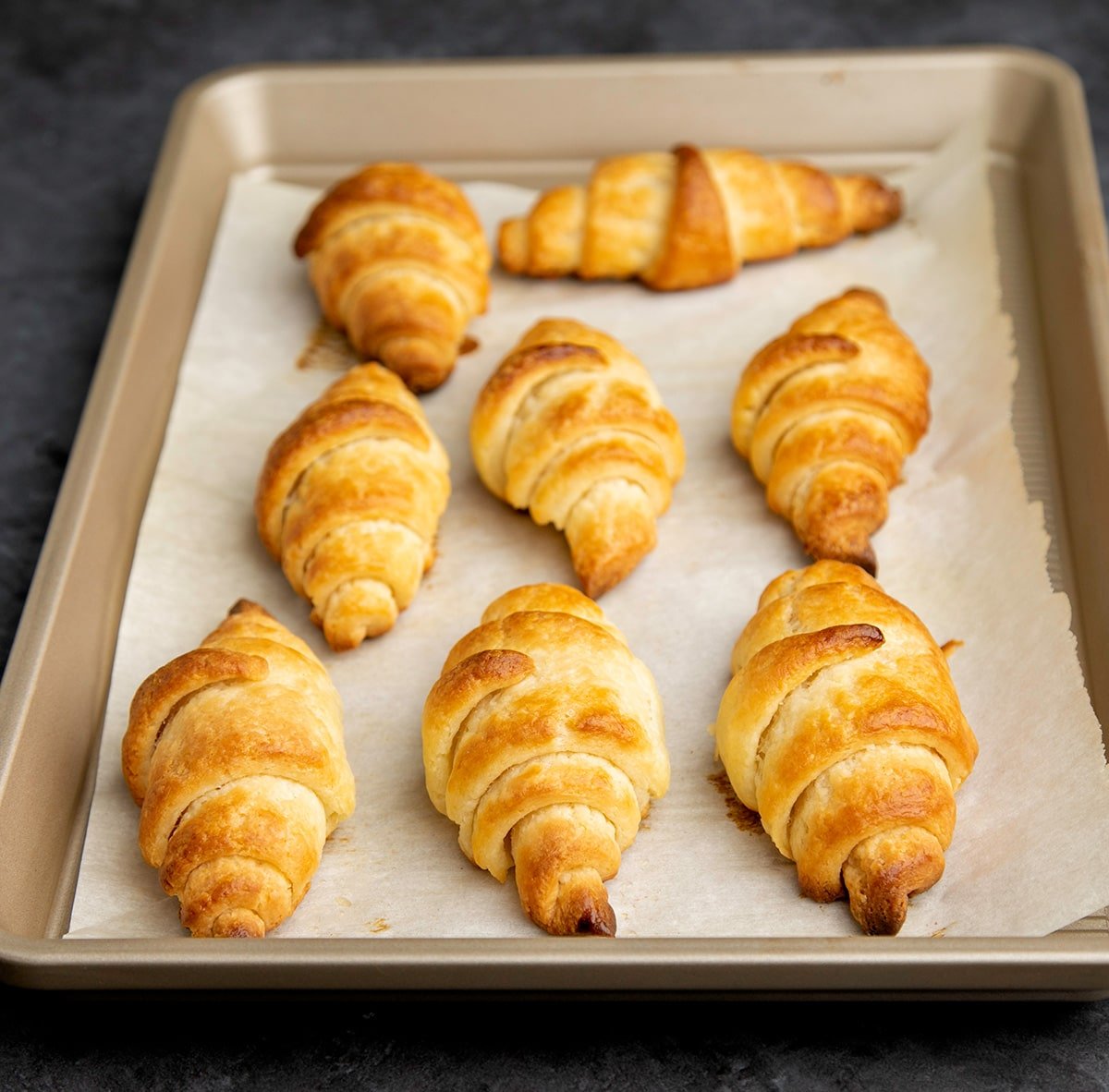
- Place the chilled and proofed croissants in the center of the preheated oven, one baking sheet at a time, and bake for about 20 minutes, or until deep golden brown all over and firm to the touch.
- Allow to cool briefly before serving.
Video
Tell Google you trust GFOAS!
Notes
- 80% all purpose gluten free flour blend (with xanthan gum), by weight (in one cup or 140 grams, 80% is 112 grams)
- 10% cornstarch, by weight (in cup or 140 grams, 10% is 14 grams)
- 10% milk powder, by weight (in cup or 140 grams, 10% is 14 grams)
- 280 grams all purpose gluten free flour blend (with xanthan gum*)
- 35 grams cornstarch
- 35 grams milk powder
I no longer recommend Cup4Cup gluten free flour because they changed their formula. It functioned on its own like a pastry flour. If you'd like make your own version of the previous formula, please follow my recipe for mock Cup4Cup.
Nutrition
Nutrition information is automatically calculated, so should only be used as an approximation.














Hi again, I made these with some success and want to try again. The flavour was good and they were beaultifully flakey in the middle. I had to use arrowroot starch as I am allergic to corn. The dough did not fold over like yours, it kept breaking, but it did laminate. I found it hard to wrap in plastic wrap because the wrap was floury and did not stick to itself or the dough. For some reason they hardly raised as well. I even put them in a warm oven to proof with a bowl of hot water. After baking they came out flakey but crispy on the edges. Do you think they were crispy because of the arrowroot starch? Any ideas about the dough breaking or it not rising? Do you think it dried out in the fridge becuse it wasn’t tightly wrapped? How did you get your wrap to stick? Thanks for making this all possible ?
Here are my main troubleshooting guidelines for you, Finely:
Did you make ingredient substitutions, particularly the gf flour blend? They are not all created equal at all. Please see the AP GF flour blends page, which is linked in every recipe that calls for one, including this one. That is a very common cause for issues. It sounds like perhaps you used a high starch blend instead of one of my recommended ones.
Did you measure by weight, not volume? You can’t measure properly by volume, especially dry ingredients like flour, as human error is unavoidable.
Hi Nicole, Thanks so much for your quick reply! I used the Better Batter you reccomended and added the milk powder and (the only substitution) arrowroot starch. I used a whole sachet of dried yeast (and , when rising, it did smell yeasty). I weighed everything except the milk and the batter needed more milk than the recipe stated.
It sounds like you used active dry yeast, perhaps, not instant, Finley? Arrowroot does tend to be a bit more absorbent than cornstarch, which might also account for a difference.
Croissants and other [butter laminated doughs] do not profit from a warm oven rise as the butter melts out instead of staying between the layers of dough to help make flaky layers during baking.
Similarly keeping the butter as layers in the dough and repeatedly chilling as you form the turns is critical to nice flaky croissants
Hope this helps.
Hi there, I’m just a bit confused. I bought Better Batter AP Flour Blend. Can I use this straight or do I need to add milk powder and cornstarch? I’m also wondering if I could use part of this recipe for danish pastries. I’m so looking forward to trying this recipe :)
Please see the section of the post titled “What the best flour for gluten free croissants?” You can also click the hyperlink in the recipe card to go to the page where I discuss specifically how to use Better Batter to make my gluten free pastry flour blend by adding cornstarch and milk powder. This dough is not the same as Danish dough, which also contains eggs. You can use it similarly, but it isn’t quite the same.
Can I use 2% milk instead of whole milk?
You can try, Ann, but the croissants may turn out less tender.
Is there any way to add chocolate? I feel like anything will throw off the recipe. I guess I could put some melted on top once these are baked and cool.
I feel like you could add a piece of dark chocolate to the center, actually, Sheryl. I’ve thought about trying it so many times. Maybe just try it with a few of the croissants as you’re shaping them?
I pretty much thought this was impossible to do gluten free without some crazy chemicals, and have been mourning the loss of croissants for years. But these were INCREDIBLE. So many flaky buttery layers of pastry. I made them with a bit of honey instead of sugar because it’s all we had, and it worked great. Thank you thank you thank you!
I’m so glad, Elsa! I know that feeling you’re describing, and it’s the worst. I’ve been on a mission since 2009 to prove that nothing is out of reach!
This was my third different recipe I tried. Thank you for ending my frustration! I don’t know why didn’t go to your site first; given the success I’ve had with other recipes from your site.
They came out perrrrrrrfect.
That’s so great to hear, Patrick! Thank you for sharing your experience, and for the kind words. They mean a lot to me!
Does this gluten free croissant recipe appear in one of the cookbooks that you sell? Because I found the exact same recipe almost verbatim on another website. Somebody’s copying someone!
I’ve been developing and blogging about gluten free recipes since 2009, Deja, and I am often copied, sometimes brazenly. I’m not sure where else you’re seeing my recipe, but this is mine and mine only!
These came out quite nice! They are more buttery than I would prefer but I think they didn’t proof quite enough (didn’t quite double in size) and I’m thinking they will be better next time. I have a proofer (that I was using for kombucha brewing) but I’m afraid it’s not really reaching the temperature indicated.
Absolutely use the Instant Yeast instead of regular, and the Authentic Foods superfine rice flours. I tried with the version from Nuts.com and that didn’t come out right at all. Too bad as I was hoping to make a mostly organic mix. I did find organic potato starch and potato flakes (that I had to pulverize). Also I used Kerrygold butter, maybe a harder butter would come out different. I froze the proofed dough before baking and didn’t seem to lose too much of the butter during the bake.
I am also quite new at baking with yeasted dough, so even for a newbie, the recipe came out well.
You could put garlic and/or herbs in the butter then chill it and use it to make the croissants.
I don’t recommend that, Kim, since adding that will change the consistency of the butter.
These look great, Nicole. I am intolerant of corn and I’m wondering about the best substitute for the cornstarch in your flour for this recipe. Seems like tapioca flour would work but would change the consistency. Any suggestions? Thanks for all you do.
Hi, Adah, no, I wouldn’t use tapioca, which has other stretchy properties that cornstarch doesn’t have. You can try potato starch or arrowroot in place of cornstarch.