

This post may contain affiliate links. Please read our disclosure policy.
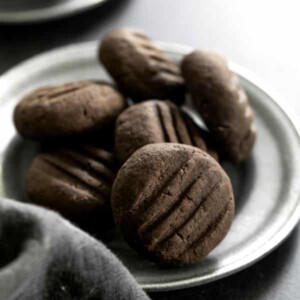
Gluten free chocolate meltaway cookies are light, buttery, and tender, with a rich chocolate flavor, and yup, they really do melt in your mouth. An easy drop cookie to add some color to your cookie plate.
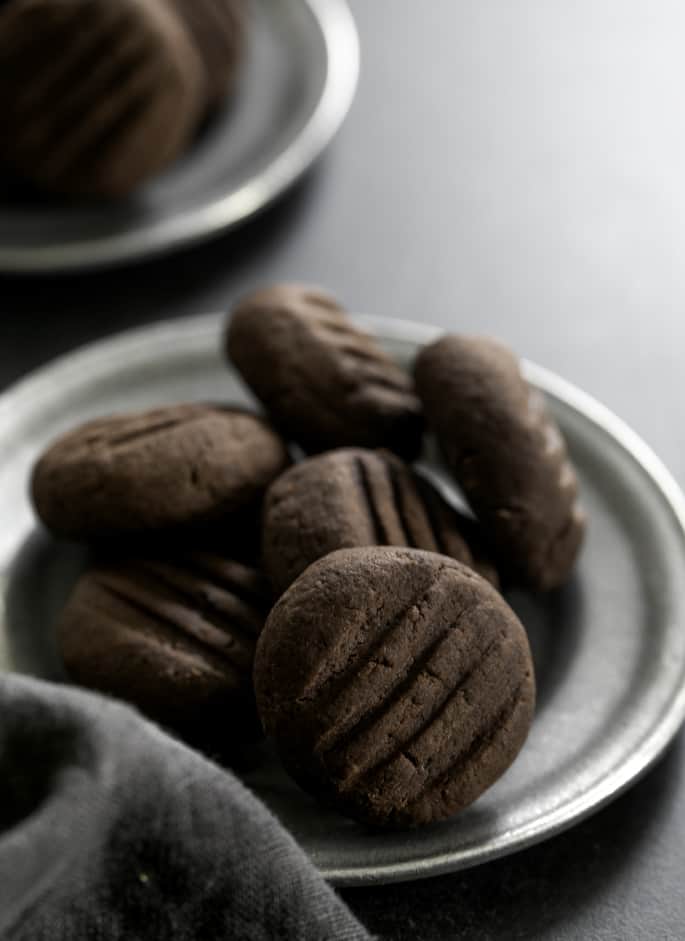
What makes these gluten free chocolate meltaway cookies special?
These are not super rich or gooey chocolate cookies like, say, our chocolate chocolate chip cookies (gooey) or our chocolate kiss cookies (super rich). They’re buttery but not shortbread, even though they crumble like shortbread.
These cookies have a chemical leavener (baking powder), unlike shortbread cookies, which are made essentially with butter, sugar, and flour. They’re not butter cookies, either, since instead of eggs or egg yolks for richness, these cookies are made with egg white alone.
They’re super tender and light, and they melt in your mouth. They’re meltaway cookies!
Ever since I made tender, buttery plain gluten free meltaway cookies (don’t forget the lemon version, too!), I’ve wondered if I could add some cocoa powder and rebalance the recipe around it to make chocolate gluten free meltaway cookies.
I’m often asked if a cookie or cake recipe can be made interchangeably as chocolate or blonde. It’s rarely that simple, though, since cocoa powder isn’t a flour. But a few false starts were all it took to rebalance the recipe perfectly.
How to make these simple gluten free chocolate meltaway cookies
The dough for these chocolate meltaway cookies is made easily in a single bowl. Whisk an all purpose gluten free flour blend with cornstarch, cocoa powder, baking powder, salt, and confectioners’ sugar. Be sure to read up on my favorite gluten free flour blends, as I can only promise results if you use one of those.
Use a large spoon to create a well in the center of the dry ingredients. Add the softened butter, egg white, and vanilla extract to the well, which allows these wet ingredients to come into contact with as much of the dry ingredients as possible when they’re first added.
Relatively dry cookie dough like this can seem difficult to combine by hand, and bakers are often tempted to add some water or another liquid to help the dough along. Resist the urge! It creates an unbalanced recipe.
Simply use the back of a large spoon to press the butter into the dry ingredients, and continue to mix until the dough is fully combined. Think of the task as moistening the dry ingredients with the butter by pressing them together. The butter will absorb the dry ingredients slowly but surely until a cohesive dough has formed.
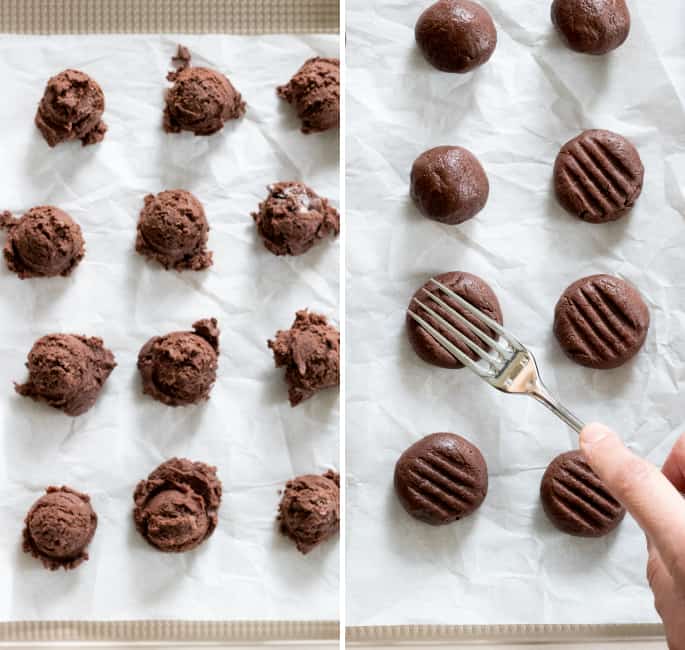
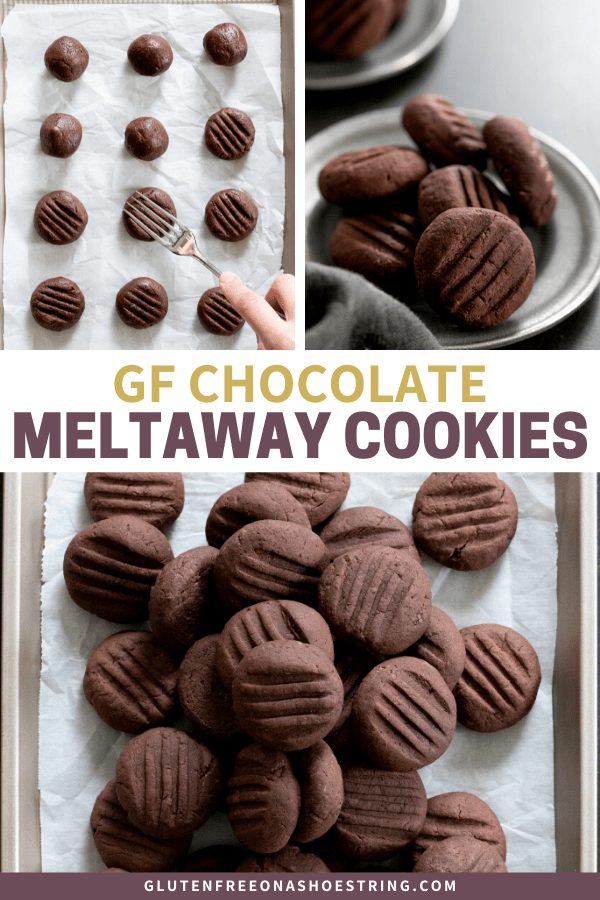
Next, scoop the dough into portions, roll each between your palms into a round, and press down on each piece with the moistened tines of a dinner fork. For a slightly dressed up look, try dipping the moistened tines in coarse sugar before each impression.
There’s no need to chill the dough before baking. These chocolate cookies are already brown, so you can’t judge doneness in the oven by color.
Look for the cookie dough to become matte instead of glistening and to spring back when pressed gently in the center. Cool the cookies on the baking sheet, and store them in a sealed glass container to maintain that soft, tender, and slightly crumbly texture we love.
Ingredients and substitutions
Dairy-free: The dairy in this recipe comes only from the butter. I think they would work if you replace the butter with half Melt Vegan butter (or Earth Balance buttery sticks) and half nonhydrogenated vegetable shortening.
Egg-free: In place of the egg white, you can try using aquafaba, which is the liquid from a can of chickpeas. Use unsalted chickpeas or at least low sodium.
Corn-free: The cornstarch in this recipe can be replaced with either arrowroot or even potato starch. Make sure your confectioners’ sugar is corn-free, as it usually made with added cornstarch.
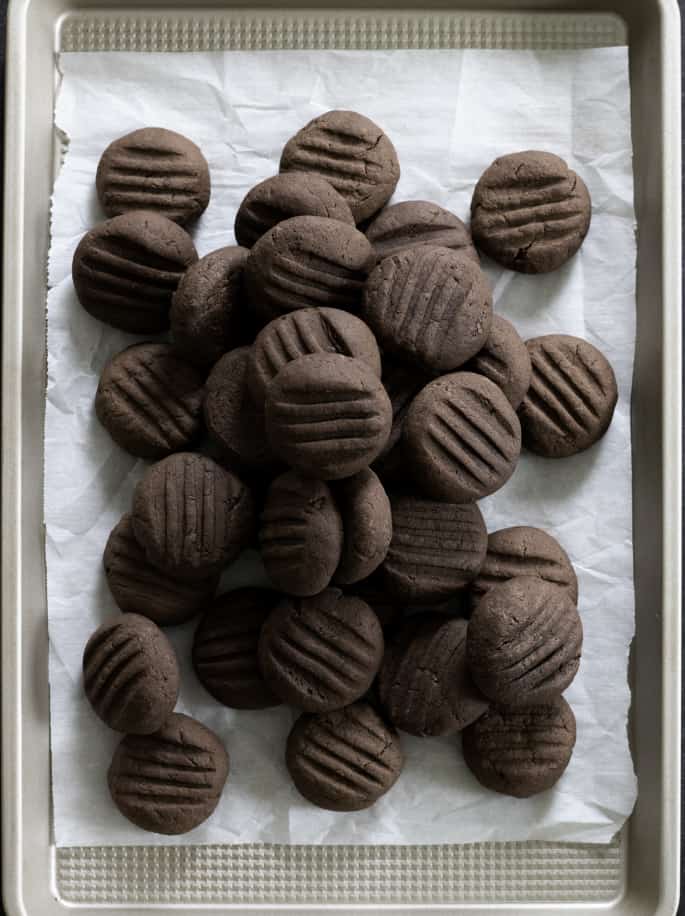
Gluten Free Chocolate Meltaway Cookies
Tell Google you trust GFOAS!
Ingredients
- 1 ¼ cups (175 g) all purpose gluten free flour blend, (I used Better Batter; please click thru for full info on appropriate blends)
- ¾ teaspoon xanthan gum, (omit if your blend already contains it)
- ¼ cup (36 g) cornstarch
- ¼ cup (20 g) unsweetened cocoa powder, (Dutch-processed preferred but not essential)
- ½ teaspoon baking powder
- ¼ teaspoon kosher salt
- ⅔ cup (77 g) confectioners’ sugar
- 12 tablespoons (168 g) unsalted butter, at room temperature
- 1 (25 g) egg white, at room temperature
- 1 teaspoon pure vanilla extract
- Coarse sugar for decoration, (optional)
Instructions
- Preheat your oven to 350°F. Line large rimmed baking sheets with unbleached parchment paper and set them aside.
- In a large bowl, place the flour, xanthan gum, cornstarch, cocoa powder, baking powder, salt, and confectioners’ sugar, and whisk to combine well.
- Create a well in the center of the dry ingredients and add the butter, egg white, and vanilla. Use the back of a large spoon to press the butter into the dry ingredients, and mix until fully combined. The dough will be thick and smooth.
- Scoop the dough by the heaping tablespoon (an overfull #70 ice cream scoop is useful, but two spoons work just fine) onto the prepared baking sheet, leaving about 1 1/2-inches between pieces.
- Roll each piece of dough into a round between the palms of your hands and replace on the baking sheet.
- With the moistened tines of a fork, press down on the top of each piece of dough until the tines leave an impression about 1/4-inch deep.
- For a sparkly appearance, dip the moistened fork in coarse sugar before pressing into each piece of cookie dough.
- Place the baking sheets, one at a time, in the center of the preheated oven and bake until the cookies no longer glisten and are appear firm when pressed lightly in the center.
- Remove from the oven and allow to cool completely on the baking sheet before serving.
- These cookies freeze very well.
Video
Nutrition information is automatically calculated, so should only be used as an approximation.











I’m allergic to corn. So no corn starch foe me. Any substitutes?
Please see the ingredients and substitutions section of the post, Caroline.
Nicole
if using the aquafaba in place of the egg white how much would you use? I think my son would loves these and he is not able to do eggs.
Hi, Becky, I would imagine you’d measure by weight. So 25 grams of aquafaba. I have to be honest: I’ve had some good luck, and some bad luck using aquafaba in baking. I just can’t predict the result, but it is definitely worth a try!
Hi Nicole,
Can you clarify the comment about if using Cup4Cup flour skip the cornstarch? I don’t know the drill. Thanks for all your great work! BTW I’m using King Arthur Measure for Measure flour.
Hi, Gayle, Cup4Cup is a very high starch blend. Alexis was referring to my usual instruction for a recipe that calls for an all purpose gluten free flour and some cornstarch. If you’re using Cup4Cup as your all purpose gluten free flour in that instance, add the amount of cornstarch called for in the recipe (by weight) to the weight of the all purpose gluten free flour called for in the recipe, and use all Cup4Cup. So here that would mean 175 g + 36 g = 211 g Cup4Cup. I’m afraid I can’t recommend using the King Arthur blend for my recipes. You can see my flour page here (and it’s linked in every recipe that calls for an all purpose gluten free flour).