

This post may contain affiliate links. Please read our disclosure policy.
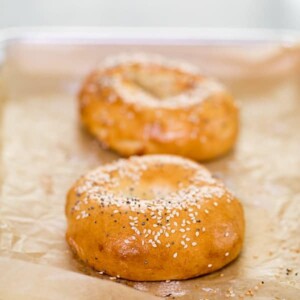
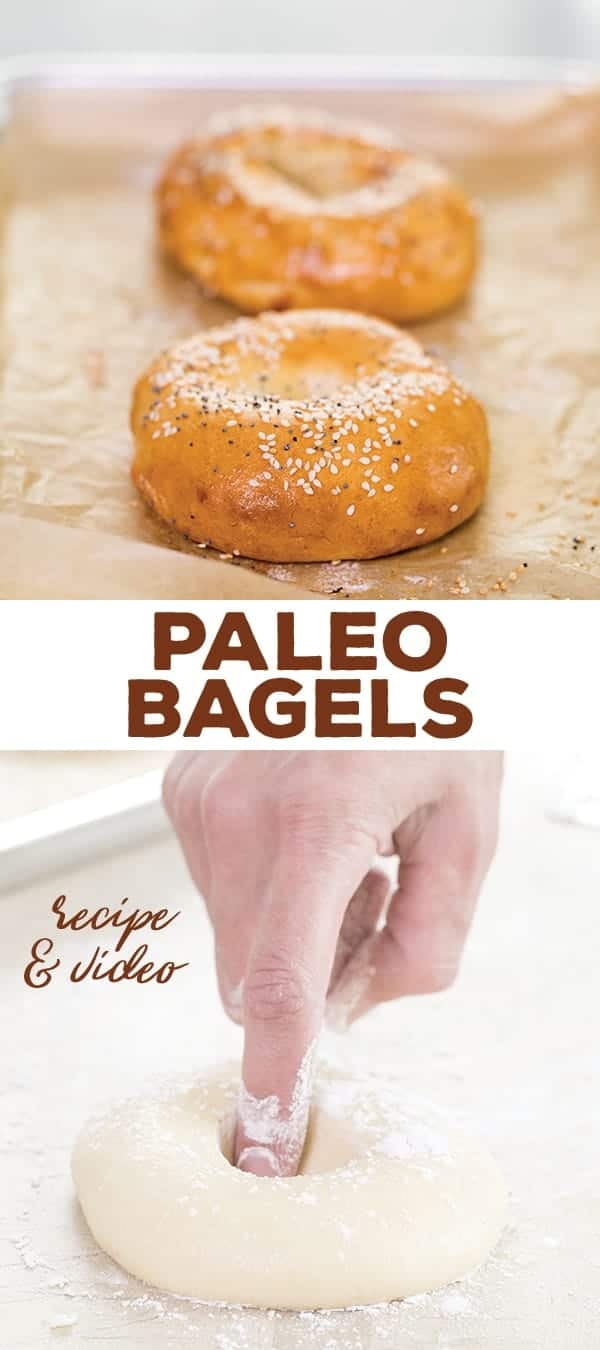
These authentic-tasting Paleo bagels have no gluten, grains or dairy, but you’d never know it wasn’t the “real thing.” Just a few ingredients, including almond and tapioca flours, are all it takes!
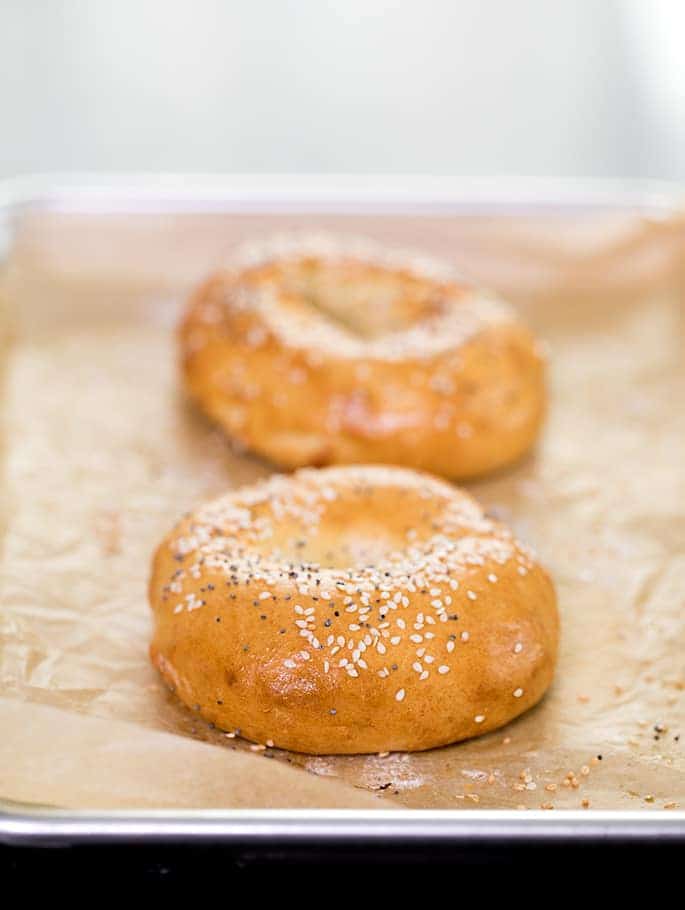
These bagels should not be allowed to rise!
Our no rise gluten free bagels are a long-time favorite, because the recipe doesn’t take any advance planning, and the bagels rise beautifully in the oven alone.
That oven rise is called “oven-spring.” It’s the rise that happens when yeast bread dough hits the heat of the oven. It’s all you need sometimes.
This Paleo bagel dough not only doesn’t need to rise outside the oven, but it shouldn’t! I’ve made this recipe many, many times and I’ve found that if the dough is allowed to rise for more than 30 minutes before being shaped, boiled and baked, it loses its shape during baking. Instead of a bagel, it looks more like an explosion.
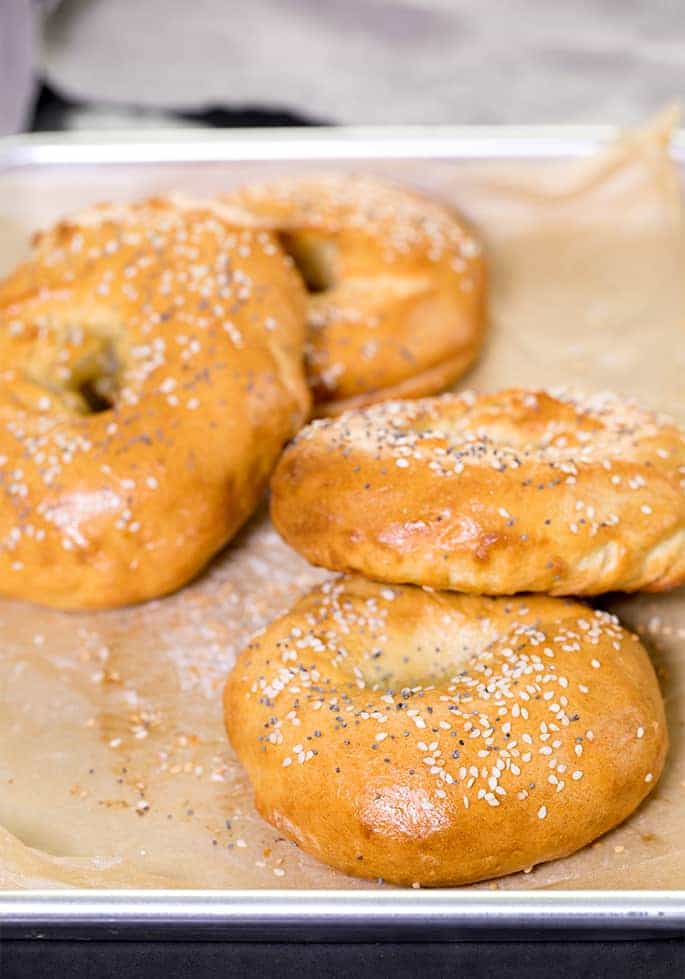
This recipe is based on our recipe for Paleo Pizza here on the blog, which is one of my favorite Paleo baking recipes. The balance of almond flour and tapioca flour is somewhat different in this recipe than it is in pizza, and there are more eggs.
When I used a higher percentage of almond flour in the bagels, they were super difficult to handle and way too soft to hold their shape.

What’s great about making these Paleo bagels
The good news about shaping these bagels using tapioca starch/flour (note: tapioca starch and tapioca flour are different names for the same thing!) is that you don’t have to worry about using too much.
Use as much tapioca starch as you need to shape the bagels easily, and they’ll still rise in the oven. In fact, if you don’t use extra flour to shape the bagels, they’re more likely to fall apart during boiling.
And don’t skimp on the boiling! Boiling the raw dough makes bagels more chewy than other bread by forcing the dough into a more definitely shape before baking. That way, the bread doesn’t rise as much and the crumb stays tighter.
What do these Paleo bagels taste like?
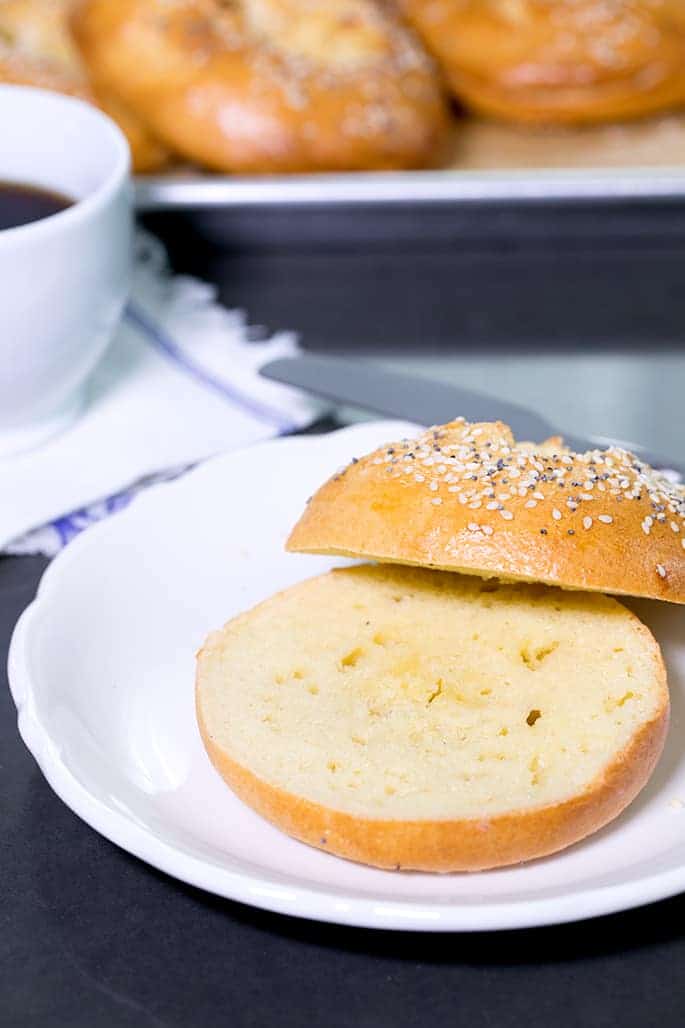
These taste like New York bagels to me, since they’re really nice and chewy inside. And the crust outside is almost a little crackly, but never hard to bite or tough. The tapioca does its job of creating that amazing texture, and the almond flour provides some richness and depth of flavor.
If you need to swap out this ingredient or that, please read all about ingredients and substitutions below. Simple recipes like this should really be made as written, if at all possible, but of course you’re always free to experiment!
Paleo bagel ingredient and substitution information
Eggs
This is a really hard one, as there’s one egg per every two bagels in this recipe. They do quite a lot of work in both binding the recipe and in helping the bagels rise.
You can try one “chia egg” per whole egg in this recipe, but I’m not terribly hopeful it would turn out. A “chia egg” is one tablespoon ground chia seeds + one tablespoon lukewarm water, mixed and allowed to gel.
For the egg wash that’s brushed on top after boiling and before baking, you can try just using nondairy milk. The bagels just won’t brown as well.
Almond flour/nuts?
Finely ground blanched almond flour is a key component of this recipe. Be sure to use only the finely ground flour, and not almond meal or the recipe won’t work. If you’d like to try to make these nut-free, you can try using sunflower seed flour, but I honestly don’t know if it will work.
Tapioca starch/flour
Tapioca starch/flour simply has absolutely no true equal in baking. It’s an amazing finely ground starch that’s low in calories and incredibly soft and stretchy. If you can’t have tapioca, I’m afraid you simply can’t make this recipe.
Be sure to use good quality tapioca flour, as it varies quite a bit from brand to brand. I really like Authentic Foods tapioca flour, but like all their products it’s pricey. I usually buy tapioca flour from nuts.com.
Authentic Paleo Bagels
Tell Google you trust GFOAS!
Ingredients
- 1 ½ cups (180 g) blanched superfinely ground almond flour
- 3 ½ cups (420 g) tapioca starch/flour, plus more for dusting
- 1 teaspoon (6 g) kosher salt
- 2 teaspoons (6 g) instant yeast
- 3 (150 g (weighed out of shell)) eggs, at room temperature, beaten
- 1 tablespoon (21 g) honey
- 2 tablespoons (28 g) extra virgin olive oil
- ⅝ cup (5 ounces) cool water
- Boiling bath, (4 cups water + 1 tablespoon coconut palm sugar + 1/2 teapsoon kosher salt, brought to a boil)
- Egg wash, (1 egg + 1 tablespoon nondairy milk,beaten)
- Sesame and poppy seeds, for sprinkling (optional)
Instructions
- Preheat your oven to 375°F.
- Line a rimmed baking sheet with parchment paper, sprinkle it with a thin layer of tapioca starch or spray with cooking oil spray. Set the baking sheet aside.
Make the bagel dough.
- In a large bowl or the bowl of a stand mixer fitted with the paddle attachment, place the almond flour, tapioca starch/flour and salt, and whisk to combine.1 1/2 cups blanched superfinely ground almond flour, 3 1/2 cups tapioca starch/flour, 1 teaspoon kosher salt
- Add the yeast, and whisk again to combine.2 teaspoons instant yeast
- Create a well in the center of the dry ingredients and add the eggs, honey, oil, and water, and mix until well-combined.3 eggs, 1 tablespoon honey, 2 tablespoons extra virgin olive oil, 5/8 cup cool water
- The mixture will be very soft at first, but will become more firm as it sits.
- Cover the bowl with plastic wrap and place it in the refrigerator for only about 10 minutes.
- While the bagel dough is chilling, bring the boiling bath to a boil in a medium-size stockpot over medium-high heat.
Shape the bagels.
- Sprinkle a flat surface generously with tapioca flour, and place about 1/3 of the slightly chilled bagel dough in the center.3 1/2 cups tapioca starch/flour
- With well-floured hands, turn the dough over to coat it and press it into a disk.
- Using a bench scraper or sharp knife, divide the dough into two equal portions. In between well-floured and cupped palms, shape each piece of dough into a thick round and place on the prepared baking sheet.
- Work quickly, to avoid allowing the dough to rise or get very warm.
- Repeat with the remaining dough, placing the pieces about 2 inches apart on the baking sheet.
- Poke a floured forefinger into the center of each piece of dough and wiggle around to create a hole.
Boil the bagels.
- Place the shaped bagels in the boiling water bath no more than two at a time to prevent crowding and sticking, and boil for about 1 minute per side.Boiling bath
- Try to prevent the dough from sticking to the bottom of the pot by swirling the water around.
- The bagel will float once it’s been boiling for about a minute. Using a strainer, remove the bagel from the boiling water and return to the baking sheet.
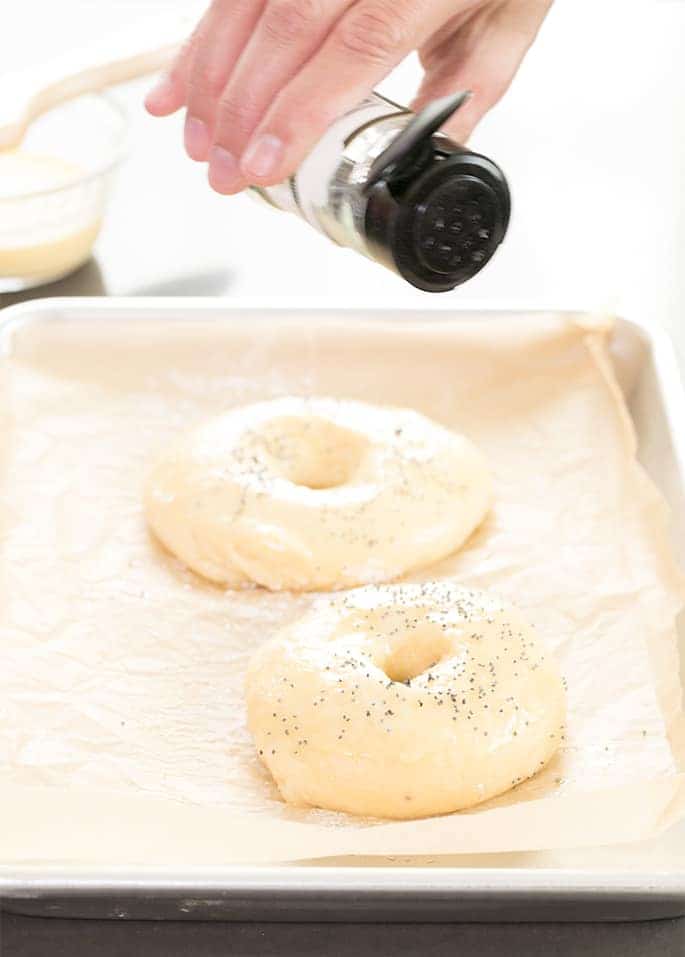
- Repeat with the remaining shaped pieces of dough. Brush each bagel generously with the egg wash, and sprinkle with the seeds, if using.Egg wash, Sesame and poppy seeds
Bake
- Place the baking sheet in the center of the preheated oven and bake until the bagels are uniformly golden brown all over, and firm to the touch (about 25 minutes).
- Remove from the oven and allow to cool at least slightly before slicing and serving.
Storage suggestions
- Freeze any leftovers by first slicing each bagel the placing in a freezer-safe bag, eliminating as much air as possible and sealing tightly.
- Defrost at room temperature. They freeze amazingly well.
Video
Notes
Nutrition
Nutrition information is automatically calculated, so should only be used as an approximation.










Can I substitute aquafaba for the eggs? Will it provide enough binding?
Hi, Carol, you can try that, but I haven’t tested it myself so I’m not sure if it would work. The egg whites are responsible for helping the bagels maintain their shape as they cool.
In the video, why is the boiling water so dark? It only has, according to the recipe, coconut sugar, and salt. That doesn’t make it that color. What else is in there?
Coconut sugar is very dark, Jeff.
Thank you for the amazing recipe! I did 2oz warm water with active dry yeast and a tablespoon of honey, and let it sit for 20 mins until frothy. Then proceeded as normal! I topped the bagels with cheese and they are fluffy and amazing.
Hi I tried to add 2 comments for assistance but they do not display?
And all comments are moderated on my website, to guard against spam and aggressive comments. You will always have to wait for me to approve them before they display. Please be patient and considerate.
Additional comment – Your video for 2 bagels shows about 5 oz of water – what is the correct water amount for the full recipie – I measured by oz on scale dry ingredients
Again, there is no error in the recipe. The eggs add a significant amount of moisture, and there’s plenty of oil. The recipe works when made as written.
How can only 5oz of water in this recipie make 5 cups of flour moist (31/2 tapioca and 1/12 almond)? Batter was like sand – I had to add much more water.
Was there an error in the water amount?
There’s no error in the recipe, Pam. Almond flour is very oily.
Hi,
I’ve made this recipe for the second time and the bagels fall apart in the water boil. I’m not sure what I’m doing wrong but I followed the measurements exactly using a scale. I still bake them and they taste great but they don’t rise, I’m assuming because they haven’t been boiled. They almost melt and break apart in the water. Any suggestions would be helpful :)
Hi, Jenna, did you use superfinely ground blanched almond flour, and good quality tapioca flour/starch in the recipe? If you used almond meal or a gritty almond flour (like, unfortunately, Bob’s Red Mill), the bagels wouldn’t hold together. And did you use instant yeast, not active dry yeast? If you use active dry yeast, you need 25% more yeast by weight, and to hydrate it ahead of time or it won’t activate properly. I hope that’s helpful!
hello, I have made the bagels and also the mock against the grain rolls and im having trouble with them getting really hard, almost inedible. im thinking its over baking, what’s your suggestion?
It’s almost for sure overbaking, but you may also be overmeasuring flour if you’re measuring by volume, not weight, Heidi.
I am nut free, can rice flour be substituted?
Thanks
No, definitely not, Eva-Lynn. Rice flour and almond flour are not at all interchangeable. For more thoughts on replacing almond flour, please see the ingredients and substitutions section under the heading “Almond flour/nuts?”
Hi! Thanks for this awesome recipe! First time ever making bagels =) I have 2 questions
1) Do you have a suggestion for storing the bagels if I don’t want to freeze them/intend to eat them in the next couple days? Or should I default to freezing whatever isn’t eaten right away?
2) Do you have any tips for shaping? 2 of my bagels came out looking like proper bagels and the other ones looked kind of uneven, lumpy, or the holes filled in. They taste amazing so I’m happy, but would love to get more uniform-looking bagels in the future
Hi, Camille, I’m so glad you gave them a shot! I don’t recommend storing any of them anywhere other than the freezer. Day old bread is day old bread, and the refrigerator will dry them out. I’m not sure what to suggest for shaping other than to recommend that you watch the how-to video on this blog page. Whatever you did to smooth out the dough with those 2 is what you should do for all of them! I’m afraid I don’t have any way to know what you did differently. I do discuss using as much tapioca starch as necessary to shape them, so maybe that’s what made the difference.